Conquering the Predictability Desert: How an MIT-Led AI Breakthrough Is Revolutionizing Subseasonal Weather Forecasting

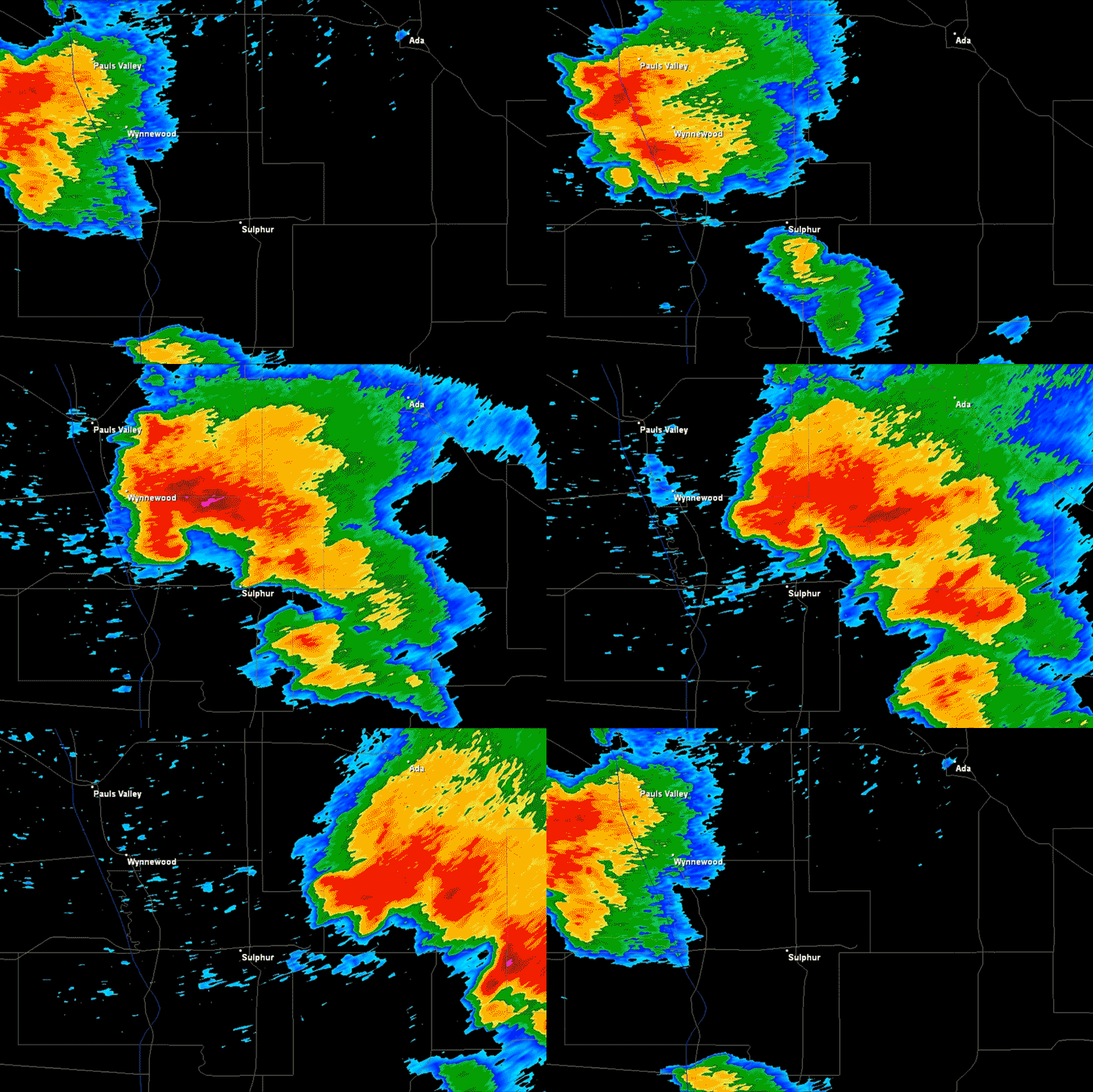
In February 2021, the state of Texas experienced a catastrophic failure of its energy infrastructure, an event triggered by three consecutive, severe winter storms that swept across the region. The resulting disruptions crippled electricity grids, caused widespread water pipe bursts, and depleted essential food and heating supplies. At least 246 people lost their lives during the crisis, which laid bare the vulnerabilities of modern municipal and energy systems when confronted with sudden, extreme meteorological shifts.
Energy operators, agricultural planners, and emergency management officials agreed in the aftermath that additional lead time could have substantially mitigated the destruction. With even an extra week or two of advanced warning, logistics teams could have rerouted natural gas trucks to vulnerable facilities, utilities could have winterized infrastructure more aggressively, and municipalities could have issued early evacuation or shelter orders. However, traditional weather forecasting horizons have historically suffered from a hard technical limit. While short-term forecasts of up to two weeks are moderately reliable, projections stretching further out have been notoriously imprecise, leaving a dangerous blind spot in global disaster preparedness.
Today, a collaborative team of researchers anchored by the Massachusetts Institute of Technology (MIT), Microsoft, and prominent international forecasting centers has unveiled a machine-learning breakthrough that promises to close this gap. By developing an advanced AI-driven postprocessing model that corrects errors in existing meteorological systems, the researchers have effectively doubled forecasting accuracy over a critical two-to-six-week timeframe. Described in a landmark paper published in the journal Nature, the new technique marks the first time an operational model has consistently outperformed long-term climatological averages in the notoriously difficult subseasonal forecasting window.
Navigating the Predictability Desert
For decades, meteorology has contended with theoretical boundaries established in the 1970s by Edward Lorenz, a pioneer of chaos theory at MIT. Lorenz demonstrated that infinitesimal variations in initial atmospheric conditions generate entirely divergent weather outcomes, creating a theoretical ceiling of roughly two weeks beyond which standard forecasting degrades rapidly. Atmospheric noise grows exponentially, eventually overwhelming the initial observational signal.
This paradigm created what researchers refer to as the "predictability desert"—the subseasonal window spanning two to six weeks. In the short-term range of zero to two weeks, forecasters leverage highly accurate initial conditions captured by satellites and ground sensors. In the long-term range of seasons and years, climatologists rely on slow-moving boundary forces, such as ocean-atmosphere phenomena like El Niño or La Niña. The subseasonal range, however, benefits from neither approach.
"In the subseasonal range, you can’t take advantage of either of those," explains Judah Cohen, a research scientist in the MIT Department of Civil and Environmental Engineering and a co-author of the new study. "In most cases, forecasting in the subseasonal ranges is no different than going to a casino and rolling the dice."
Historically, meteorologists have relied on two primary methodologies: dynamical models, which use massive supercomputers to numerically simulate the physical fluid dynamics of the Earth’s atmosphere and oceans, and purely data-driven artificial intelligence models trained on historical observations. While AI has advanced short-term weather prediction significantly, it has traditionally struggled even more than dynamical models over extended horizons.
The Power of the Postprocessing Wrapper
Recognizing these persistent shortcomings, the research team—led by Harvard undergraduate Hannah Guan, University of Toronto postdoctoral researcher Soukayna Mouatadid, MIT alumni Genevieve Flaspohler, Brazilian mathematician Paulo Orenstein, Jeremy Berman of DTN, European Center for Medium-Range Weather Forecasts (ECMWF) researchers Jakob Schloer and Joshua Talib, and Microsoft researchers Alex Lu, Haiyu Dong, Jonathan Weyn, Zekun Ni, and Lester Mackey alongside MIT’s Cohen—took a radically different path.
Rather than building a brand-new forecasting model from scratch, the team engineered an intelligent machine-learning "wrapper" designed to sit on top of existing meteorological systems.
"We built this wrapper—Lester calls it postprocessing," Cohen notes, referring to long-time collaborator and Microsoft researcher Lester Mackey. "We know AI models have a lot of errors, so we thought maybe we can quantify those errors and remove them."
Instead of employing traditional linear bias correction—which tends to pull extreme meteorological events back toward the mathematical mean, inadvertently smoothing away the very anomalies disaster planners need to see—the team’s AI framework studies historical forecast errors. By analyzing how established models miscalculated past weather patterns, the machine-learning layer dynamically adjusts current and future predictions. The model updates adaptively as fresh observational data flows into the system.
The researchers leveraged MIT Engaging, a powerful supercomputing cluster maintained by the MIT Office of Research Computing and Data, to train the model. Crucially, however, once trained, the resulting postprocessing tool is computationally lightweight and does not require a supercomputer to run, making it highly accessible for meteorological offices worldwide with limited IT infrastructure.
Triumph on the Global Stage
To validate their approach, the research team entered three model configurations incorporating their postprocessing layer into the European Center for Medium-Range Weather Forecasts (ECMWF) forecasting competitions. The ECMWF is widely regarded as the premier global forecasting institution, routinely hosting rigorous evaluations to benchmark the world’s best meteorological systems.
The team’s top-performing submission combined ECMWF’s gold-standard dynamical model with a secondary system, layered with their proprietary AI error-correction wrapper. The resulting synthesis doubled the predictive power of the original model in the subseasonal range. More importantly, it achieved a historic milestone: for the first time, a subseasonal forecasting system reliably beat long-term climatological averages.
"Up until now, no one had been able to show a model predicts weather better than long-term averages for these subseasonal forecasts," Cohen states. "They’ve pretty much all been worse than that—you could literally flip a coin and do better. People have questioned if it’s even worth investing in models at all for this time range. We consistently beat climatology averages with our models."
Furthermore, the model demonstrated exceptional skill in predicting extreme weather events, such as severe cold snaps, heavy flooding, and intense heatwaves. While traditional error-correction techniques fail in these scenarios by averaging out extremes, the MIT-led approach accurately flags anomalies lurking on the fringes of probability distributions.
Global Applications and Disaster Preparedness
The implications of extending reliable weather visibility into the two-to-six-week window extend far beyond academic achievement. By transforming subseasonal forecasting from a guessing game into a dependable science, governments, agricultural sectors, and energy grids gain a vital buffer against climate-induced volatility.
International interest has already materialized. The meteorological office of the Republic of Kenya has initiated discussions with the research team to implement the model ahead of the annual monsoon season, aiming to optimize agricultural planning and secure food supplies.
"This could help you decide when to fertilize around rain, when there’s a freeze coming to protect crops during winter harvests, or help you avoid droughts," Cohen says. "It could also be useful for energy and emergency management. I’ve talked to energy officials who say, ‘If I’m told two days before that an ice storm’s coming, I don’t have enough time, but if I had two weeks, that could be enough to make adequate preparations.’"
Because the postprocessing layer functions as an open-source, model-agnostic add-on, it can be integrated seamlessly with existing forecasting architectures globally, whether operated by national weather services in wealthy industrialized nations or resource-constrained developing countries.
As extreme weather events become more frequent and severe due to shifting global climate patterns, tools that bridge the "predictability desert" will become indispensable components of civil defense. By providing critical weeks of advanced warning, this new generation of AI-enhanced forecasting offers societies a fighting chance to protect infrastructure, conserve vital resources, and save lives.