Beyond the Leaderboard: A Critical Analysis of AI Agent Benchmarking Standards

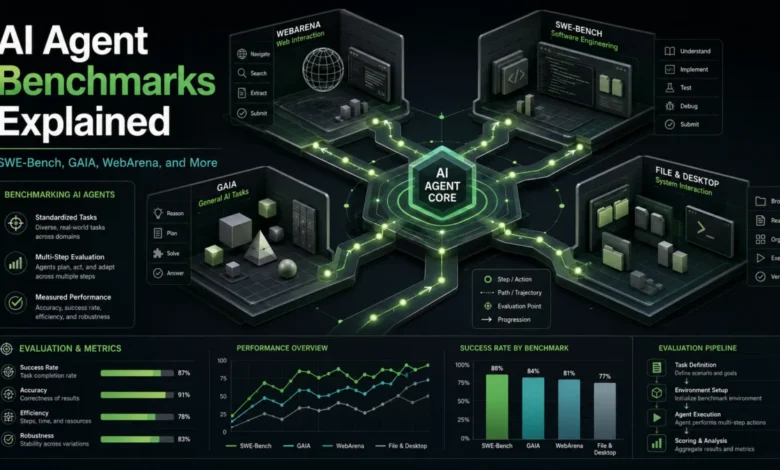
The rapid proliferation of AI agents capable of autonomous decision-making has triggered an arms race among technology providers, each vying to prove their models are state-of-the-art through a dizzying array of performance metrics and leaderboard rankings. However, for enterprise developers and organizations attempting to integrate these autonomous systems into production workflows, the correlation between high benchmark scores and real-world utility remains tenuous at best. As the industry matures, a clear distinction has emerged between traditional static model evaluations and the complex, multi-step environments required to test true agentic behavior. This article provides a comprehensive examination of the current AI agent benchmarking landscape, detailing how these evaluations function, where they fail, and why they should be treated as directional indicators rather than absolute performance guarantees.
The Evolution of Model Evaluation
The history of machine learning evaluation was long dominated by static, single-turn benchmarks. In the early 2020s, frameworks such as MMLU (Massive Multitask Language Understanding) and HumanEval became the industry standard for measuring raw reasoning and code generation capabilities. These tests operate on a simple stimulus-response paradigm: the model receives a prompt, generates a singular output, and is graded against a ground-truth reference. While these metrics effectively tracked the exponential growth in Large Language Model (LLM) intelligence, they failed to account for the iterative nature of modern agents.
The shift toward "agentic" evaluation began in earnest around 2023, as the community recognized that the ability to answer a question is fundamentally different from the ability to execute a task. Unlike traditional models, agents operate in environments where they must observe state, plan sequences, utilize external APIs, and recover from intermediate failures. This transition necessitated a move from "test-set" evaluation to "work-simulation" evaluation, marking a new era in AI research where success is defined by goal completion rather than text generation accuracy.
Decoding the Major Agent Benchmarks
To understand the current state of the field, one must examine the four primary benchmarks that dominate the discourse: SWE-Bench, GAIA, WebArena, and OSWorld.
SWE-Bench and the Quest for Software Engineering Autonomy
SWE-Bench, introduced as a challenge for software engineering agents, represents one of the most rigorous testing grounds currently available. It requires an agent to navigate real-world GitHub repositories, identify the root cause of a specific issue, and write a functional patch. The 2024 iteration, SWE-Bench Verified, addressed widespread criticism regarding the original dataset, which contained ambiguous tasks and flawed unit tests. By filtering for tasks that are demonstrably solvable by human engineers, the "Verified" subset provides a more reliable metric for assessing an agent’s ability to manipulate codebases. Despite this, industry analysts note that SWE-Bench is not a panacea; it measures the ability to pass an automated test, not the maintainability or architectural integrity of the resulting code.
GAIA: Measuring General AI Assistance
The GAIA (General AI Assistants) benchmark focuses on tasks that are conceptually simple for humans but notoriously difficult for machines, such as coordinating multi-step research or cross-referencing disparate data sources. Launched as a collaborative effort to move beyond multiple-choice questions, GAIA evaluates an agent’s tool-use efficiency. However, a limitation inherent in GAIA is its reliance on "single-answer" outcomes. Real-world assistant tasks are rarely so binary; they often involve shifting requirements and subjective user preferences that a static benchmark cannot replicate.
WebArena and BrowserGym: Simulating the Web
WebArena and the associated BrowserGym framework represent the frontier of web-based automation. By simulating sandboxed e-commerce and forum environments, these benchmarks test an agent’s ability to interact with the DOM, click buttons, and interpret visual interfaces. The primary concern among researchers currently involves "data contamination." Because these benchmarks are public, there is a significant risk that newer models have been inadvertently trained on the test data, leading to inflated scores that reflect memorization rather than generalized navigation capabilities.
OSWorld: The Desktop Frontier
OSWorld represents the most ambitious attempt to date to evaluate an agent’s capability within a full operating system environment. By placing an agent in a sandboxed desktop, OSWorld tests the ability to manipulate files, adjust system settings, and manage multi-application workflows. While this is the closest approximation to a human assistant, it introduces significant technical overhead. The instability of simulated operating systems means that a failure in the evaluation environment itself can result in a failing score, regardless of the agent’s actual reasoning capability.
The Hidden Costs of Performance
A critical oversight in current leaderboard culture is the total absence of metrics regarding efficiency. A "top-performing" agent on a leaderboard may achieve its score through massive consumption of compute resources—a phenomenon often referred to as "brute-forcing" the benchmark.
Supporting data from recent research suggests that the cost-per-task for high-performing agents can vary by orders of magnitude. Furthermore, latency—a key factor for any user-facing product—is rarely reported in these public evaluations. For organizations, an agent that achieves a 90% success rate at the cost of $5.00 and 10 minutes per task is often less viable than an agent that achieves an 80% success rate at $0.05 and 5 seconds per task. The failure of current benchmarks to account for these economic realities represents a significant gap between academic research and commercial deployment.
Implications for Enterprise Integration
The lack of standardized safety and boundary-following metrics further complicates the landscape. Currently, no major benchmark consistently evaluates whether an agent respects security protocols, refuses destructive actions, or properly handles data privacy. As agents are granted deeper access to corporate systems, the risk of "prompt injection" or unintentional data exfiltration becomes a paramount concern.
Industry leaders, including organizations like the AI Safety Institute, have begun advocating for "Red Teaming" benchmarks, which measure an agent’s propensity to fail gracefully or refuse instructions that violate safety policies. This signals a maturation of the field, shifting from simple "can it do it?" metrics to "should it be allowed to do it?" assessments.
Strategic Recommendations: Beyond the Score
For developers and decision-makers, the following framework is recommended for evaluating AI agents:
- Use Benchmarks as a Filter: View leaderboards as a way to discard underperforming architectures. If a model fails consistently on standardized tasks, it is unlikely to succeed in specialized, proprietary environments.
- Prioritize Private Evaluations: The most effective benchmark is one that mimics your specific production environment. If your business relies on CRM data entry, build a test suite that requires the agent to interact with your specific CRM interface under real-world constraints.
- Focus on Error Recovery: A model’s capability is best measured by its reaction to failure. Assess how the system behaves when it encounters a 404 error, a malformed input, or an unexpected UI change.
- Factor in Economics: Incorporate "tokens-per-task" and "latency-per-task" as primary KPIs in your internal evaluations.
Conclusion
AI agent benchmarks like SWE-Bench and OSWorld have undeniably accelerated the field, providing a common language for researchers and developers to describe capability. However, they remain snapshots of a dynamic, rapidly evolving ecosystem. The temptation to rely on a single, high-ranking score on a public leaderboard can lead to costly production failures. To build truly robust autonomous systems, organizations must look beyond the noise of weekly leaderboard updates and invest in rigorous, context-specific testing that mirrors the complexity of their unique operational workflows. The future of AI agency lies not in the perfection of a test score, but in the reliability of the agent when the test environment disappears and the real world takes over.