How to Build a High-Engagement Private Members-Only Community on WordPress with PeepSo

The digital landscape has shifted significantly in recent years, moving away from fragmented, open social media networks toward concentrated, private online communities. Industry data indicates that niche community platforms see engagement rates up to 40% higher than general-purpose social networks, as users increasingly prioritize safe, curated environments for professional development, hobbyist collaboration, and exclusive knowledge sharing. For WordPress administrators, however, creating these environments has historically been a technical hurdle, often requiring the "Frankenstein-style" stitching of incompatible plugins for gated access and social functionality.
A private members-only community is supposed to feel like a destination, but most of the WordPress versions feel like a locked filing cabinet. The traditional methodology involves deploying one plugin to act as a gatekeeper and a secondary, often disparate, plugin to manage the user experience behind that gate. This leads to friction; the gate might function correctly, but the internal "rooms"—the profiles, activity streams, and messaging systems—often feel cold, disconnected, and difficult to navigate.

PeepSo has emerged as a disruptive force in the WordPress ecosystem by reversing this architectural philosophy. Rather than securing a site after it has been built, PeepSo constructs the community environment from the ground up, with native security and privacy controls integrated into the core framework. By prioritizing the social experience—profiles, groups, activity streams, and real-time messaging—as the foundation, the platform treats access restriction as a configurable layer rather than an afterthought.
The Architectural Evolution of WordPress Communities
The shift toward self-hosted community management is largely driven by a desire for data sovereignty. According to recent market analysis, over 65% of community managers are migrating from third-party platforms to self-hosted solutions to avoid algorithm-based suppression and to maintain full ownership of their user data. PeepSo’s approach to this demand is to provide an out-of-the-box solution that reduces the average deployment time for a feature-rich social network to under 60 minutes for the core build.
The timeline for a typical deployment begins with the installation of the PeepSo Foundation plugin. Upon initial activation, an automated setup wizard streamlines the creation of essential community pages—such as the Activity Stream, Member Directory, and User Profile pages. This guided process is a response to the long-standing critique that WordPress community plugins are notoriously complex to configure, often requiring weeks of custom development to achieve a professional aesthetic.

Strategic Configuration and User Management
The success of a private community is predicated on its onboarding flow. Industry best practices suggest that an overly rigorous registration process can result in a 70% drop-off rate, while a lack of vetting leads to spam and a degradation of community culture.
PeepSo addresses this through a centralized "Accounts & Security" configuration hub. Administrators are empowered to set granular requirements, such as mandatory email verification, administrative approval for new accounts, and custom password complexity standards. The platform also allows for the expansion of profile fields. While default fields such as name and biographical data are standard, the ability to add custom fields—such as industry-specific identifiers or professional certifications—allows for a more tailored member experience.
Data-driven insights suggest that administrators should limit mandatory registration fields to no more than three. By deferring non-essential data collection until after a user has established a profile, community managers can optimize the initial signup conversion while still building a comprehensive database of member interests over time.

Fostering Engagement via Activity Streams and Groups
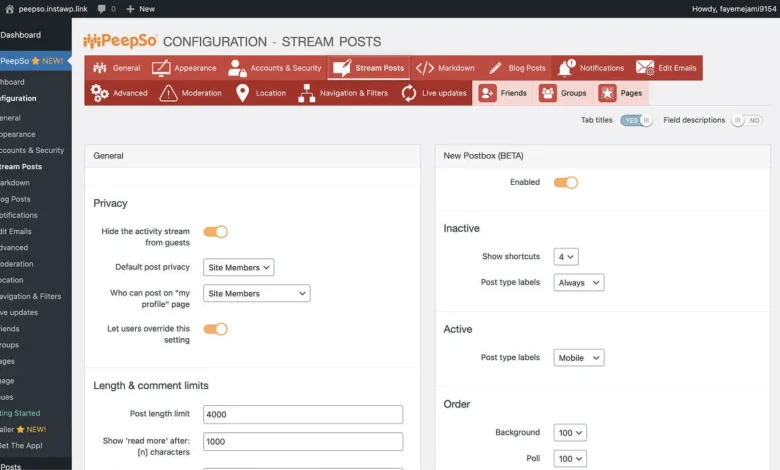
The Activity Stream serves as the heartbeat of the community. In a private environment, the quality of interaction is the primary driver of retention. Unlike public social media platforms that rely on vanity metrics, private communities thrive on deep-thread conversations. PeepSo’s stream configuration allows administrators to enable or disable specific features such as link previews, GIF support, polls, and media uploads based on the specific culture of the community.
For instance, a professional coaching network may prioritize link previews and polls to facilitate knowledge sharing, while a creative arts community might prioritize image and video gallery functionality. By granularly controlling these features, administrators prevent "feature bloat," ensuring that the interface remains clean and focused on the intended purpose of the group.
The implementation of "Groups" acts as a secondary layer of engagement. By creating smaller, thematic sub-communities, administrators provide members with a reason to return. The platform supports tiered privacy settings for these groups:

- Public: Visible and joinable by all members.
- Private: Visible to all, but content is restricted to members.
- Secret: Hidden from the directory, accessible only by direct invitation.
Scaling Through Role-Based Access and Monetization
As a community grows, the need for moderation and role-based authority becomes critical. PeepSo provides a "User Limits" feature that allows administrators to assign specific permissions to different WordPress user roles. This tier-based system is an effective tool for community management, allowing administrators to reward high-performing members with elevated permissions—such as the ability to create groups or manage events—without the immediate necessity of a paid membership.
For organizations looking to monetize their digital assets, the platform offers a robust integration with Paid Memberships Pro. This allows for the seamless mapping of membership tiers to specific WordPress roles. The integration follows a logical progression:
- Configuration: Define membership levels (e.g., Bronze, Silver, Gold).
- Payment Gateway Integration: Securely connect Stripe or PayPal.
- Role Mapping: Use the "Roles for Membership Levels" add-on to automate access control.
This automation ensures that when a user completes a payment, their permissions are updated in real-time, granting them immediate access to the relevant community sections. The implications for business owners are significant: by shifting to a paid subscription model, community owners can generate recurring revenue, which can be reinvested into content development, moderation, and community events.

Implications for Data Sovereignty and Long-Term Stability
The move toward self-hosted, private community platforms represents a broader trend of "digital decentralization." By utilizing WordPress and PeepSo, administrators are not merely buying software; they are securing their intellectual property and social capital on infrastructure that they control.
Analysis of the current digital landscape shows that communities built on third-party SaaS platforms are vulnerable to sudden changes in terms of service, pricing, and algorithmic reach. Conversely, a community built on a self-hosted architecture provides a permanent, scalable asset. The ability to integrate other enterprise-grade tools—such as LearnDash for e-learning or WooCommerce for e-commerce—further extends the utility of the platform.
As the community evolves, the initial focus on "who the community is for" remains the most important metric. Whether it is a professional network, a hobbyist forum, or a paid coaching group, the technical framework provided by PeepSo serves as the scaffolding for long-term growth. By following the established configuration steps—securing the gate, defining the rooms, and implementing sustainable access tiers—administrators can build a thriving, proprietary community that functions as a sustainable business asset rather than a temporary online gathering.

The final test of any community launch remains the "member walk-through." By auditing the experience as a standard user—ensuring that privacy settings are functioning and that the interface is intuitive—administrators can mitigate friction before the official launch. This commitment to a seamless user journey, combined with the power of self-hosted WordPress, ensures that the community is not just a collection of files, but a vibrant, private space for meaningful human connection.