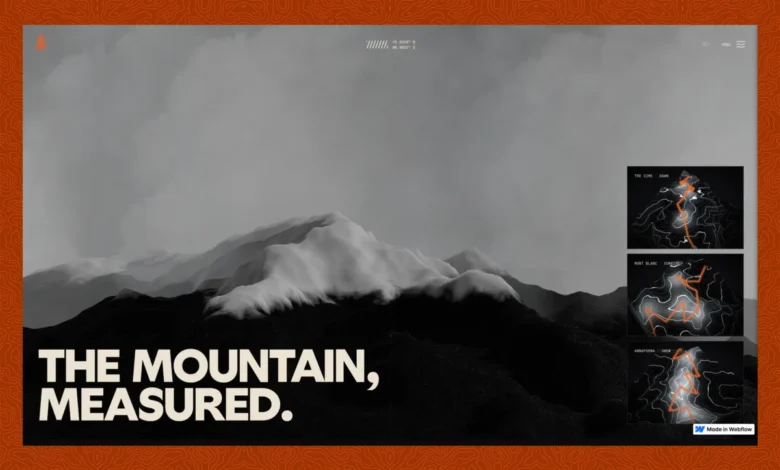
The digital design landscape has reached a new milestone with the release of Ridgeline, a cinematic hiking and photography platform that successfully integrates high-fidelity, real-time 3D terrain into a standard Webflow environment. Developed as a personal engineering challenge by creator Filip, the project addresses a long-standing technical hurdle in web development: the ability to host genuine 3D elevation data, rendered live via Three.js, without compromising the editability and accessibility of a Content Management System (CMS). By utilizing actual Digital Elevation Models (DEMs) and a sophisticated automated workflow involving artificial intelligence, Ridgeline demonstrates a shift in how immersive web experiences are constructed, moving away from pre-rendered video loops and toward dynamic, interactive geometry.
Project Genesis and Core Philosophy
The development of Ridgeline was driven by a single investigative question: can a Webflow site host real-time 3D terrain derived from actual geographic survey data while remaining a "human-editable" project? Traditionally, high-end 3D web experiences require bespoke, hard-coded environments that are difficult for non-technical users to update. Ridgeline sought to bridge this gap by creating a hybrid architecture where the visual structure is managed in Webflow’s Designer, while the complex 3D logic and assets are handled via an external JavaScript pipeline.
The project was guided by a strict architectural rule: the 3D elements had to be visible and interactive, regardless of whether they were built-in components or external scripts. This decision ultimately led to the creation of three distinct "condition" scenes representing real-world alpine treks: "Dawn" (modeled after the Tre Cime in the Italian Dolomites), "Sunrise" (Mont Blanc), and "Snow" (Annapurna). These scenes are interconnected through scroll-driven photography, ambient soundscapes, and an interactive atlas homepage that allows users to fly through the terrain in a seamless transition.

The Technical Chronology: From GPS to GPU
The construction of Ridgeline followed a rigorous technical timeline, compressed into approximately one week through the use of advanced AI agentic workflows. The process began with the acquisition of geographic data. For the "Dawn" scene, the developer utilized a personal GPS track recorded above Cortina d’Ampezzo. This data was exported from Strava as a GPX file, cleaned of signal spikes, and then draped onto a true Shuttle Radar Topography Mission (SRTM) slope model.
The 3D pipeline proceeded through a specific sequence of engineering stages:
- Data Modeling: Geographic elevation data was processed in Blender to create a survey-contour mesh.
- Export Optimization: The models were exported to the glTF format using Draco mesh compression. This reduced static mesh sizes by a factor of 5 to 13, shrinking 11MB files down to approximately 1MB.
- Real-time Rendering: The assets were loaded into a Three.js environment, where a custom fragment shader was applied to create a "survey-map" aesthetic. This shader reads the world-space height of the mesh to generate contour lines dynamically, rather than relying on static textures.
To maintain performance, the developer implemented a "persistent WebGL context" strategy. Rather than tearing down and recreating the 3D canvas during page navigation—a common cause of "black flashes" and memory leaks—the site performs a PJAX swap of scene data while the canvas remains active.
Integration of AI and the Model Context Protocol (MCP)
One of the most significant aspects of the Ridgeline project is its reliance on the Webflow Model Context Protocol (MCP). The entire site—including pages, CSS classes, variables, and SEO metadata—was built and maintained by an AI agent (Claude) driving the Webflow MCP server. This represents a paradigm shift in web development, where the developer acts as an architect overseeing an agent that executes the manual labor of building components and managing custom code.

The project adopted a "CDN-First" behavior model. While the markup and CSS reside within the Webflow Designer as named components, the 3D behavior and animations are hosted as versioned JavaScript on Cloudflare R2. This allows for rapid iteration of complex logic without the need to manually re-publish the Webflow project for every minor code adjustment.
Performance Engineering and Optimization Data
A primary goal of the Ridgeline project was to achieve a consistent 60 frames per second (fps) across various devices. This required aggressive optimization of both the GPU and the main execution thread. The developer utilized a custom in-page FPS profiler to identify "jank" and frame drops in real-time.
According to technical logs, several key optimizations were implemented to stabilize performance:
- GPU-Driven Particles: In the "Snow" scene, the falling snow was moved entirely to the GPU. By using a shader to handle the movement and wrapping of particles, the CPU load was significantly reduced, moving the scene from 37fps to a locked 60fps.
- Asynchronous Compilation: To prevent the main thread from freezing during scene transitions, the developer utilized the
compileAsyncmethod. This allows the browser to compile shaders and upload textures off the main thread, eliminating a roughly 1,000ms freeze that occurred during the initial reveal of the 3D models. - Layout Thrash Prevention: For scroll-driven animations, the developer avoided animating CSS properties like
widthandheight, which force the browser to recalculate the layout every frame. Instead,transform: scalewas used, which is handled more efficiently by the browser’s compositor.
The following data illustrates the performance gains achieved through these optimizations:

| Section | Initial Performance | Optimized Performance |
|---|---|---|
| Homepage Intro | 46fps (min 33) | 60fps (min 56) |
| Snow Scene | 37fps | 60fps |
| Summit Reveal | ~1000ms freeze | Negligible lag |
| Footer Entrance | 7fps (minimum) | 57fps (minimum) |
User Experience: Audio and The "First-Paint" Challenge
Beyond the visual 3D elements, Ridgeline incorporates a sophisticated audio engine designed to enhance the cinematic atmosphere. To comply with browser restrictions regarding autoplaying media, the site utilizes an "audio gate"—a preloader that requires a user gesture (clicking "Enter") to unlock the ambient sound bus. The audio system features proximity-based volume controls, where the intensity of the ambient sound (wind, snow, or storm) fluctuates based on the camera’s distance from the terrain.
Furthermore, the developer addressed the issue of the "first-paint flash." On many high-fidelity sites, a split-second of white or unstyled content appears before the JavaScript-driven loader takes over. Ridgeline solved this by injecting a "flash guard" directly into the Webflow head custom code. This synchronous CSS ensures the background is dark and the content is hidden the moment the browser begins to render the page, providing a seamless transition into the preloader.
Industry Implications and Future Outlook
The Ridgeline project serves as a case study for the future of "low-code" and "pro-code" convergence. By proving that high-performance WebGL and complex 3D pipelines can coexist within a CMS like Webflow, the project opens new doors for creative agencies and independent designers who wish to push the boundaries of web-based storytelling.
Industry analysts suggest that the use of AI agents and protocols like MCP will likely become standard for high-end web builds. The ability to generate complex structures from code while maintaining a human-editable interface reduces the "technical debt" typically associated with bespoke web experiments. Furthermore, the emphasis on real geographic data (DEMs) suggests a growing trend toward "digital twins" and more authentic representations of the physical world in digital spaces.

In his reflections, the developer noted that while the 3D engineering was a success, the most time-consuming aspects of the build were the "seams"—the transitions between states, the timing of loaders, and the handling of edge cases. This highlights a fundamental truth in modern web engineering: as tools for creating complex visuals become more accessible, the value of a developer shifts toward fine-tuning the user experience and ensuring cross-platform stability.
Ridgeline stands as a testament to the fact that cinematic, real-time 3D is no longer the exclusive domain of dedicated game engines or heavy, hard-coded frameworks. Through pragmatic engineering, AI-assisted workflows, and a deep understanding of browser performance, the web can now host experiences that are as technically rigorous as they are visually stunning.