The AI Agent Memory Stack: Building Blocks, Patterns, and Frameworks

The Stateless Limitation of Current LLMs
The architecture of contemporary language models, such as GPT-4, Claude 3.5, or Llama 3, is fundamentally stateless. Each request to an API or inference endpoint is treated as an isolated event. While techniques like Retrieval-Augmented Generation (RAG) have allowed developers to inject external context into the model’s prompt, this process is generally limited to static document retrieval. It does not account for the temporal evolution of a task or the learning process of an agent over weeks or months of operation.
This limitation creates a "contextual ceiling." In scenarios ranging from autonomous software engineering to complex data research, the inability to recall intermediate state often leads to redundant computation, hallucinations regarding previous progress, and a total failure to maintain long-term alignment with user intent.
Categorizing the Architecture of Memory
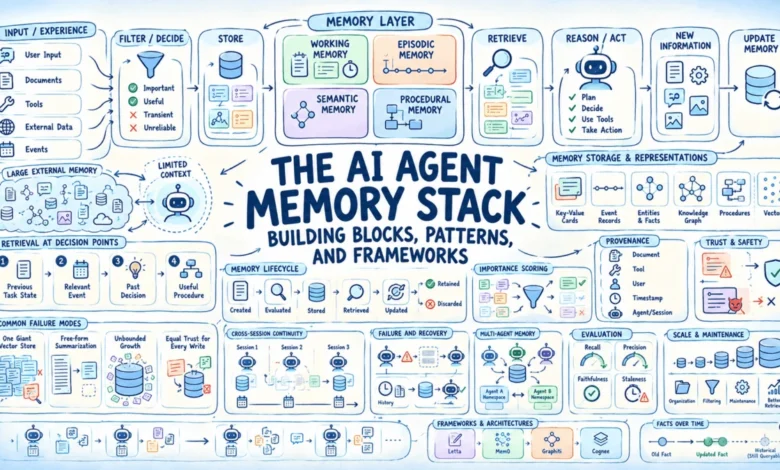
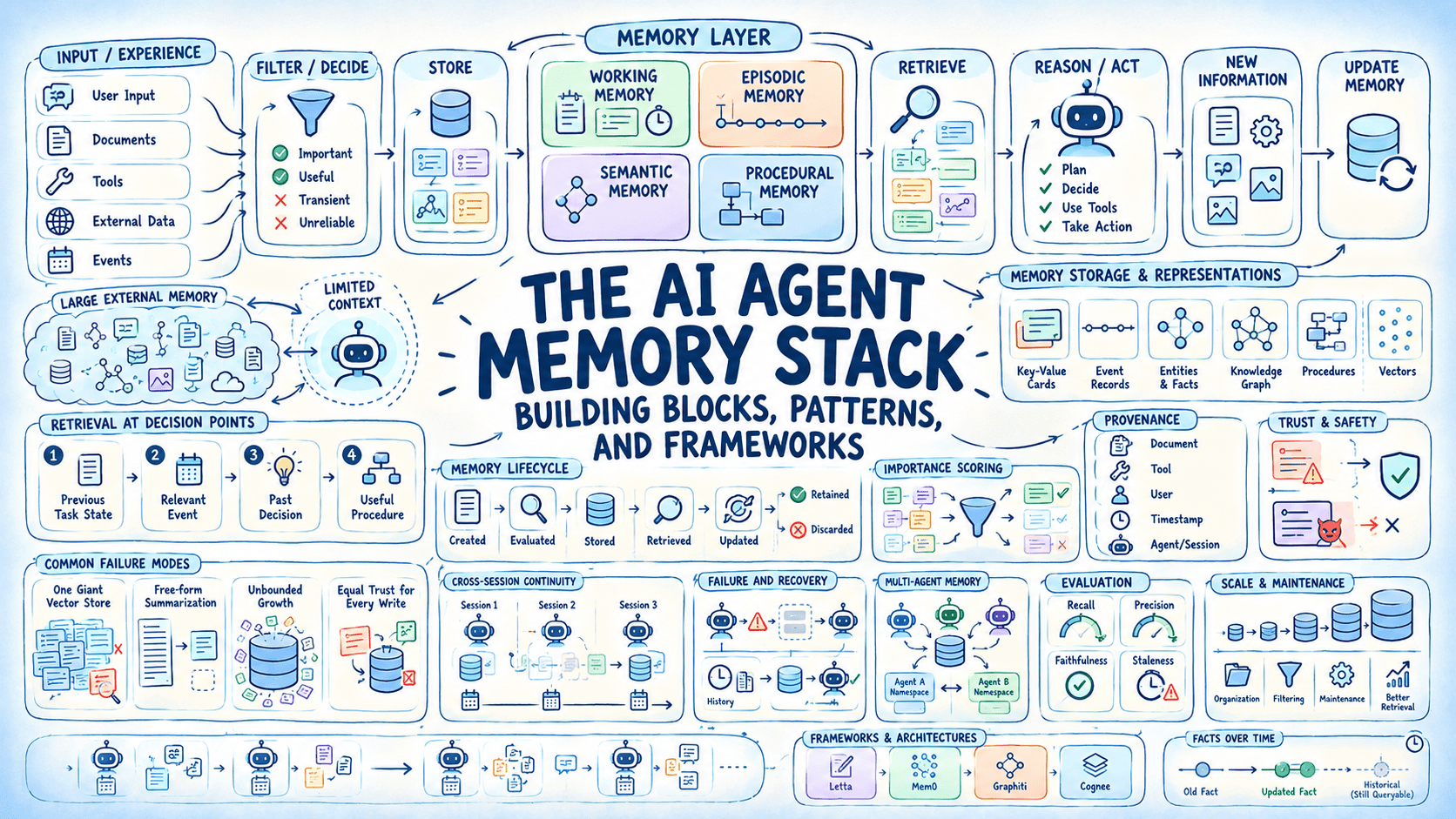
To overcome these limitations, developers are increasingly adopting a tiered memory architecture. Much like human cognition, which separates short-term sensory processing from long-term conceptual understanding, AI memory is being partitioned into four distinct categories:
- Working Memory: This represents the active scratchpad for an agent. It holds intermediate results, variables for ongoing calculations, and immediate task state. It is typically low-latency and high-frequency, often residing in RAM or transient key-value stores.
- Episodic Memory: This is the record of specific past experiences. It is essentially an audit log of what happened, when it happened, and the resulting outcome. It is typically stored as a time-ordered log or within vector databases to facilitate semantic search when the agent needs to "remember" a specific event from last Tuesday.
- Semantic Memory: Unlike episodic memory, which focuses on events, semantic memory focuses on facts and entities. This layer maintains a persistent knowledge base of user preferences, verified environmental truths, or project constraints.
- Procedural Memory: This encompasses the "how-to" knowledge of the agent. It includes successful action patterns, workflow templates, or refined prompt instructions that the agent has learned to optimize over time.
The Evolution of Memory Frameworks
The transition from simple document retrieval to complex agent memory has catalyzed a new ecosystem of frameworks. Leading the charge are specialized tools designed to manage the complexity of stateful AI.
Letta (formerly MemGPT) has gained significant traction by proposing a model where the agent can manage its own memory hierarchy, treating it like an operating system manages RAM and disk space. By allowing the agent to "write" to its own memory, it creates a self-optimizing loop. Conversely, tools like Mem0 and Cognee focus on the "knowledge graph" approach. These frameworks argue that simple vector embeddings—the industry standard for the past three years—are insufficient because they fail to capture the relational depth between different pieces of information.
By utilizing Knowledge Graphs, these frameworks allow agents to reason across entities. For example, if an agent is tasked with a market analysis, it can track the relationship between a CEO’s public statement, a stock price fluctuation, and a historical industry trend, rather than simply retrieving a list of "similar" documents.
Practical Implementation: The Research Agent Case Study
Consider an enterprise-grade research agent deployed to track international trade policy. In a naive implementation, the agent would query a search engine, summarize the top results, and then reset. In a memory-augmented architecture, the agent’s lifecycle looks drastically different:
- Day 1: The agent records initial data points in its episodic log.
- Day 2: It identifies a contradiction between a new report and the data stored on Day 1. Instead of simply appending, the agent uses its "Semantic Memory" layer to flag the contradiction for human review or updates its internal knowledge graph.
- Day 3: The agent utilizes its "Procedural Memory" to realize that a specific source consistently provides inaccurate data, and it updates its internal "trusted sources" list to weight that site lower in future iterations.
This progression moves the agent from a reactive tool to a proactive analyst. However, this level of sophistication introduces the "Memory Poisoning" risk—a significant concern for enterprise security. If an agent continuously learns from its environment, it is susceptible to adversarial data injection. Consequently, modern memory frameworks are increasingly integrating "human-in-the-loop" verification steps to ensure that the information stored in the long-term knowledge base remains accurate and sanitized.
The Technical Debt of Unbounded Growth
A primary challenge currently facing engineers is the "memory bloat" phenomenon. If an agent logs every single interaction, the memory store becomes noisier over time, leading to lower-quality retrieval results. Industry leaders, including teams at MongoDB and various AI infrastructure startups, have begun emphasizing "Memory Engineering."
This discipline involves:
- Pruning/Garbage Collection: Periodically deleting low-value entries or summarizing older episodic logs into compact semantic summaries.
- Importance Weighting: Assigning metadata tags to memories based on their utility. A decision that resolved a major system error is weighted significantly higher than a routine status update.
- Hierarchical Retrieval: Implementing a tiered search strategy where the agent first queries the high-confidence semantic knowledge base before defaulting to a broader, potentially less accurate episodic vector store.
Future Implications and Evaluation
The shift toward persistent agent memory has profound implications for the labor market and software development. As agents become capable of retaining context over months of project lifecycles, the threshold for what constitutes an "automated task" is rising. We are moving toward a paradigm where software is no longer a static application, but a living entity that learns from every interaction.
However, the field currently lacks a standardized benchmarking framework for memory. While we have robust metrics for LLM accuracy (e.g., MMLU, GSM8K), we have few ways to measure "memory efficiency." As the industry matures, the focus will likely shift from raw model intelligence to the quality of the memory stack supporting the agent.
In conclusion, the development of robust AI agent memory is not merely an optional feature; it is the prerequisite for the next wave of AI utility. By moving beyond the stateless limitations of current models and implementing structured, multi-layered memory architectures, developers can create agents that are truly capable of independent, longitudinal problem-solving. As frameworks like Letta, Mem0, and Graphiti continue to refine their approach to persistence and knowledge representation, the barrier between a "chatbot" and an "autonomous agent" will effectively vanish. The focus for the next 24 months will be on standardization: building the protocols for how agents store, share, and evaluate their own experience in an increasingly complex digital landscape.