How Isadora Agency Built a Digital Stress-Relief Web Experience Using Lottie and DOM Math Instead of Traditional Physics Engines

When front-end developers and user experience engineers are tasked with designing web interfaces that feel tactile, elastic, or physically reactive, the industry-standard reflex is to immediately incorporate a physics engine. Frameworks such as Matter.js, Cannon.js, or bespoke WebGL implementations have long stood as the gold standard for creating immersive, gamified web applications. These tools excel at simulating gravity, friction, and chaotic collisions, providing a quick path to believable motion.
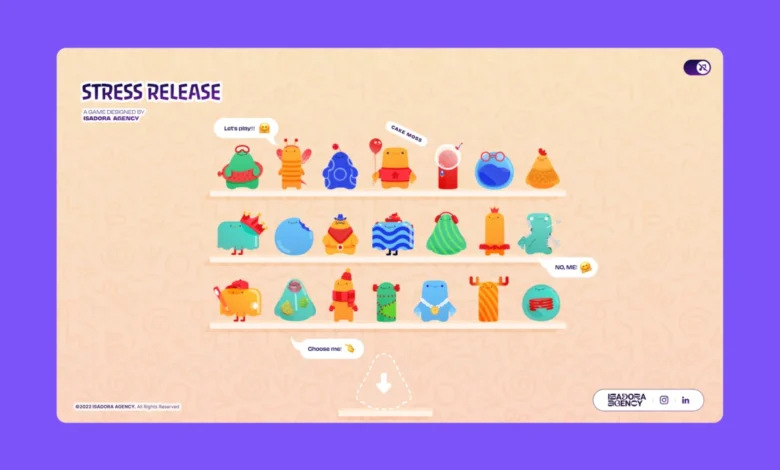
However, a team of developers and designers at Isadora Agency recently discovered that when building a deeply stylized digital product, algorithmic simulation can often work against the core vision of the art direction. When engineering Stress Release—a digital stress-relief squeeze toy application built to let burnt-out creatives smash, stretch, and distort animated user interface characters—the development team faced a fundamental philosophical choice: embrace the unpredictable realism of a physics engine or enforce strict, deterministic control over every single frame of animation.
The Architectural Challenge: Intentional Motion Versus Physics Simulation
The primary objective of the Stress Release project was to construct a highly tactile environment where every user click yielded an immediate, satisfying, and visually distinct squishy reaction. During the initial prototyping phase, engineers experimented with traditional physics-based libraries to govern character reactions.
The immediate realization, however, was that physics engines produce plausible motion, whereas the project’s animators had produced intentional motion. The design team did not want the animated characters to behave like erratic rubber balls bouncing unpredictably across a canvas. Instead, the characters required highly specific, meticulously designed reactions that adhered strictly to an artistic narrative. For example, a heavy "mega squeeze" interaction demanded an exact 181-frame build-up sequence followed by a precisely timed release transition. Allowing a physics engine to calculate approximations on the fly would overwrite the nuanced keyframes crafted by the animators.
To solve this dilemma, Isadora Agency scrapped traditional physics libraries entirely. Instead, the engineering team devised an architecture reliant on programmatic Lottie state controls, standard Document Object Model (DOM) manipulation, and distance-based mathematics. This approach allowed developers to maintain absolute, deterministic control over the user experience without deploying a single line of WebGL or Matter.js code.

Translating User Input into Tactile Feedback
Because the architecture relied entirely on Lottie and the standard DOM, rendering was handled natively by the Lottie runtime, which interprets JSON-based vector animations internally as Scalable Vector Graphics (SVGs). Elements were targeted directly via standard identifiers and CSS classes, allowing developers to orchestrate behaviors using a combination of Lottie animation segments, CSS transforms, and click-event geometry.
To establish a convincing tactile sensation upon interacting with a character, the team implemented radial input mapping. The process began by converting raw click coordinates from page space into the character’s local coordinate space. Every user click was measured against the character’s exact center point, translating the raw data into score metrics, feedback intensity levels, and precise placement coordinates for visual explosion effects.
By calculating the straight-line distance from the center of the click using the Pythagorean theorem, a single numerical value began to govern multiple application states simultaneously: the awarded points, the intensity of the visual feedback, and the exact spatial coordinates where the explosion animation would render. This methodology created a concentric zone system akin to a traditional dartboard, where the hitbox remained a clean, predictable circle regardless of the underlying vector complexity.

Consequently, when a user clicked the interface, the explosion Lottie asset was dynamically repositioned to the exact vector where the interaction occurred. This spatial accuracy successfully fostered the psychological sensation of physically impacting the character, entirely driven by fundamental mathematics and DOM positioning rather than heavy collision detection algorithms.
Managing Complex Animation States and Timelines
Handling desktop clicks and mobile taps through native event listeners eliminated the need for complex raycasting or secondary coordinate remapping layers. Lottie handled the underlying squash and bounce physics intrinsically through its baked-in animation curves, which were organized into distinct frame ranges representing idle loops, light reactions, heavy reactions, and final exit states.
When a user interaction occurred, the application bypassed standard continuous playback and jumped directly to the animation segment corresponding to the current state. Once the segment completed its run, native callback functions returned control smoothly back to the looping idle state. This tightly controlled state machine ensured that the interactive layer acted as a flawless, instantaneous trigger for the animation assets, preserving the integrity of the designer’s intent.

For more complex mechanics, such as the multi-stage "mega squeeze" feature, the application utilized targeted frame loops that waited patiently for user activation before executing the high-impact release sequence.
Responsive Design and Performance Optimization
Opting for a DOM-based architecture yielded significant secondary benefits regarding responsive design. By avoiding the inherent scaling complications of bounding boxes and collision vectors across disparate viewports, the development team managed scaling entirely through CSS custom properties. By recalculating viewport dimensions dynamically on every resize event, the layout adapted fluidly while Lottie SVGs scaled naturally inside their respective containers without suffering state degradation.
Nevertheless, this architectural path introduced a distinct performance hurdle: file size and rendering overhead. Loading 21 distinct character animations alongside multiple explosion variants presented a considerable memory challenge, particularly for mobile devices with constrained hardware resources.

To guarantee fluid 60 frames-per-second performance across all target devices, Isadora Agency implemented aggressive optimization strategies. For the character selection shelf—where multiple animations played simultaneously—the team initialized Lottie instances with reduced quality parameters to minimize interpolation calculations, alongside lowered playback speeds to decrease the number of frame calculations required per second. Conversely, once a user selected an individual character to play, the application allocated full rendering quality to that single focused instance, balancing visual fidelity with computational efficiency.
Broader Implications for Modern Web Development
The architectural decisions made during the development of Stress Release offer a broader lesson for front-end developers and UI/UX designers alike. While physics engines and WebGL frameworks remain powerful tools for open-ended, simulation-heavy web environments, they are not universally required for tactile, interactive design.
By carefully evaluating project requirements and recognizing when artistic intent outweighs algorithmic simulation, development teams can successfully leverage simpler, more controllable technologies. Mapping Lottie’s native timeline capabilities directly to standard DOM elements demonstrates that highly engaging, responsive, and tactile web experiences can be achieved efficiently, ensuring that the technology serves the art direction rather than dictating it.