The digital design and development landscape has long struggled with a fundamental paradox: while technology advances at an exponential rate, the human challenge of clear communication remains stubbornly complex. Naming conventions within user interface (UI) design, code architecture, and product features have grown increasingly critical as multidisciplinary teams scale. When designers, developers, and product managers speak different dialects to describe the same interface elements, friction arises. This linguistic fragmentation often leads to reduced feature adoption, inconsistent codebases, and prolonged product development cycles. To combat these systemic hurdles, industry experts and leading design systems teams have compiled an extensive array of practical guides, open-source repositories, and structured taxonomies designed to standardize nomenclature across the digital ecosystem.

The root of the naming dilemma typically manifests in two distinct extremes: choices that are overly generic, rendering them ambiguous and prone to misinterpretation, or those that are excessively specific, stripping away necessary flexibility and reusability. In software engineering, this is often compounded by the division between semantic naming and structural naming. Historically, engineering teams relied on generic identifiers like container, wrapper, or box, which offer little context regarding the content inside. Conversely, over-specific naming can lock a component into a single visual state, preventing it from adapting to future multi-theme or multi-brand requirements. As enterprises expand their digital portfolios to encompass mobile applications, web platforms, and embedded systems, establishing a unified vocabulary is no longer just a matter of cosmetic organization—it is a core requirement for scalable software architecture.

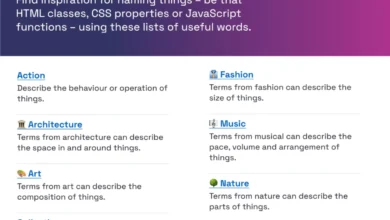
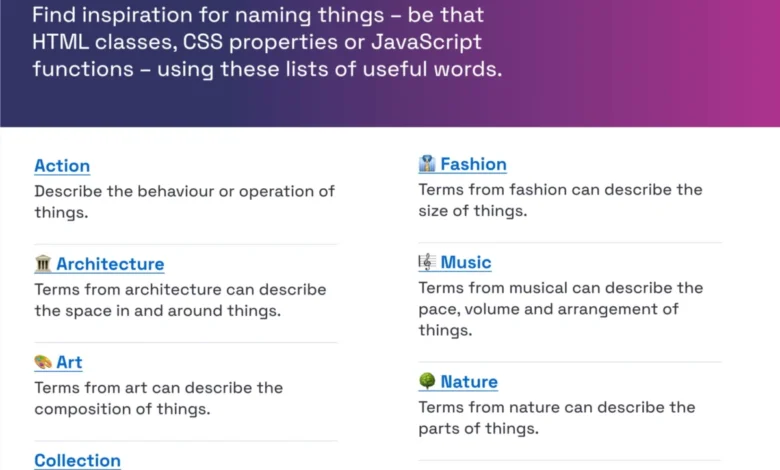
To address these challenges, developers and designers are increasingly turning to curated linguistic resources that encourage creative problem-solving outside standard corporate lexicon. Tools such as Classnames, developed by Paul Robert Lloyd, offer thematically grouped lists of words that transcend traditional programming terminology. By drawing inspiration from nature, art, theater, music, architecture, and publishing, these resources help practitioners find precise terms for behavioral traits, hierarchical ordering, and relational groupings. Similarly, color naming has historically been plagued by arbitrary hexadecimal codes and subjective descriptors like dark-blue or light-grey. Projects like David Aerne’s color-names repository, which catalogs over 30,000 unique color entries sourced from thousands of user contributions, provide systematic naming structures that bridge the gap between human perception and digital color tokens.

The establishment of rigorous design token taxonomies represents one of the most significant evolutions in modern frontend development. Design tokens—the atomic pieces of a design system including spacing, typography, and color values—require a predictable, scalable structure to function across multi-brand and multi-themed environments. Major tech enterprises have publicly shared their internal frameworks to help the broader community navigate this complexity. For instance, the engineering and design teams at Intuit developed a flexible token taxonomy to unify diverse products such as Mailchimp, QuickBooks, TurboTax, and Mint under a single architectural umbrella. By moving beyond isolated brand themes, Intuit’s system demonstrates how foundational token structures can serve multiple distinct user bases without sacrificing local brand identity.

Further expanding on token management, the Vodafone UK Design System team introduced a Variables Taxonomy Map within the Figma community to address multi-brand scalability. This map categorizes design tokens across four distinct levels: brand primitives, semantic variables, component-specific styles, and page-level applications. By building upon foundational methodologies established by industry veterans like Nathan Curtis, Vodafone’s approach allows team members to deduce a token’s exact function, hierarchy, and usage context purely from its name. Complementing these institutional frameworks are individual developer tools like Romina Kavcic’s Design Token Naming Guide and interactive builders, which provide structured spreadsheets and step-by-step methodologies to prevent naming collisions as design systems scale.
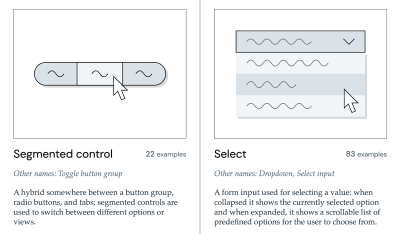
Beyond code-level variables and tokens, interface design assets—including layers, groups, and UI components—require consistent organizational standards. In his comprehensive guide on design best practices, UX expert Javier Cuello emphasizes that an effective component or layer name must be logically structured, concise, meaningful, universally understood, and strictly decoupled from transient visual properties. When teams rely on haphazard layer names like Rectangle 4 copy or Group 2, collaborative workflows break down, making handoffs between design and engineering exceptionally error-prone. To counter this, repositories like Iain Bean’s Component Gallery aggregate real-world naming conventions for over 50 standard UI elements—ranging from accordions to visually hidden utilities—allowing teams to align their internal lexicon with established industry standards.

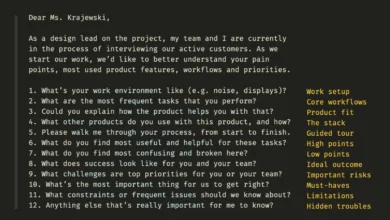
The impact of poor naming conventions extends far beyond internal team friction; it directly influences end-user behavior and feature adoption rates. Product analytics consistently show that low feature engagement is frequently rooted in discoverability issues caused by opaque labeling. When a new feature is introduced with internal code names or jargon-heavy terminology, users struggle to understand its utility within their existing workflows. UX researcher Erin Gannon’s practical guides on feature naming highlight that effective labels must be driven by user needs, signaling the specific outcome or job-to-be-done. Gannon recommends engaging directly with users to capture how they articulate their problems in their own words, thereby ensuring that interface copy and feature titles resonate with the target audience rather than internal product silos.

For organizations launching entirely new products or services, external brand naming presents an equally complex set of challenges. Open-source repositories such as Onym have emerged to centralize brainstorming frameworks, vetting methodologies, and etymological guides. These resources help product teams navigate the treacherous waters of trademark availability, cultural connotations, and linguistic pitfalls, ensuring that a brand name communicates its intended value proposition from inception. By consolidating these disparate naming resources—ranging from color repositories and feature guides to token taxonomies and UI dictionaries—digital practitioners now possess a robust toolkit to eliminate communication silos.

Ultimately, the consensus among industry leaders is that the most effective name is one that is universally understood and actively utilized across all departments, bridging the gap between designers, developers, product managers, and end-users. By auditing legacy codebases and design files for ambiguous nomenclature, addressing naming conflicts proactively, and implementing structured taxonomies, organizations can significantly reduce cognitive load and operational friction. As the digital product landscape continues to evolve toward highly integrated, multi-platform ecosystems, investing time in thoughtful, standardized naming practices remains one of the highest-return activities a technology team can undertake.