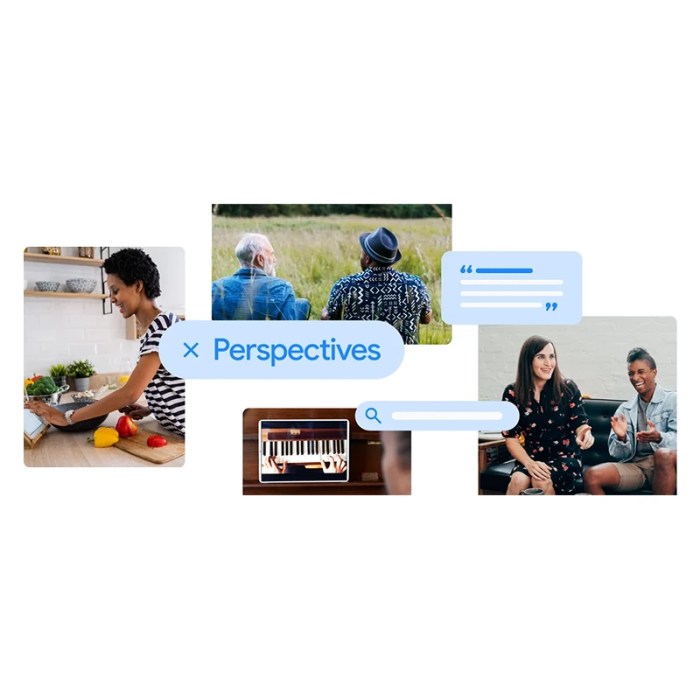

Google perspectives how this search filter delivers diverse viewpoints with engaging social content – Google Perspectives: how this search filter delivers diverse viewpoints with engaging social content, offers a unique way to explore various perspectives on current events. It goes beyond traditional search results, curating a dynamic mix of articles, news stories, and social media posts to present a multifaceted understanding of complex issues. This approach aims to provide a more comprehensive and engaging experience for users, encouraging interaction and critical thinking about different viewpoints.
The platform carefully gathers and displays diverse viewpoints, balancing conflicting opinions. It uses social media integration to show how different communities are responding to events, offering a richer understanding of the social context surrounding a topic. The design elements are designed for clarity and engagement, encouraging a deeper dive into the information presented.
Defining Google Perspectives: Google Perspectives How This Search Filter Delivers Diverse Viewpoints With Engaging Social Content

Google Perspectives is a search feature designed to provide users with a more comprehensive understanding of a topic by presenting diverse viewpoints. It goes beyond simply listing articles; it actively seeks out and highlights a range of perspectives, including those that might not be readily apparent in traditional search results. This approach aims to offer a more nuanced and complete picture of complex issues, encouraging critical thinking and informed discussion.This unique approach distinguishes Google Perspectives from other search results by prioritizing the breadth and depth of opinions on a subject.
While other search results may focus on a single viewpoint or a collection of similar viewpoints, Perspectives strives to present a spectrum of perspectives, fostering a more balanced understanding of the issue. This emphasis on diverse viewpoints is crucial in today’s information-rich environment, where encountering a variety of opinions is vital for critical thinking.
Purpose and Function of Google Perspectives
Google Perspectives aims to present a multifaceted view of a topic. It does this by aggregating diverse sources, including news articles, social media posts, and academic research, allowing users to explore a topic from multiple angles. The process prioritizes inclusivity, striving to represent various societal and political viewpoints.
Key Characteristics Distinguishing Google Perspectives
Google Perspectives differs from standard search results in several key ways. Firstly, it actively seeks out a variety of perspectives, not just those readily available. Secondly, it curates these perspectives into a coherent presentation, allowing users to easily compare and contrast different viewpoints. Thirdly, Google Perspectives often contextualizes these viewpoints, offering background information and historical context. This contextualization helps users understand the nuances of different perspectives and their historical underpinnings.
Content Types in Google Perspectives
Google Perspectives presents a variety of content types to showcase diverse viewpoints.
- News Articles: News articles provide up-to-date information from various news organizations. These articles often reflect different viewpoints on the same event or issue, highlighting the range of perspectives on a topic. For instance, different news outlets might report on a protest, with varying descriptions and interpretations of the same event.
- Social Media Posts: Social media posts offer real-time insights into public opinions and reactions to an event. This direct engagement with public discourse provides a sense of the immediate public response, revealing varying perspectives and emotions associated with an issue. For example, a social media post about a political debate might show opinions from supporters and opponents of a specific candidate.
- Academic Research: Academic research articles provide evidence-based arguments from various fields. These scholarly viewpoints often offer a deeper understanding of a topic’s complexities and are a vital component of diverse viewpoints. For example, academic studies about the effectiveness of a new policy will often highlight both positive and negative outcomes, reflecting the complexity of such measures.
- Expert Opinions: Expert opinions provide insights from individuals with specialized knowledge in a field. These opinions are often grounded in rigorous analysis and provide a well-researched perspective on a specific topic. For example, an expert opinion on climate change would be based on years of research and analysis.
Process of Gathering and Curating Diverse Viewpoints
Google Perspectives employs a sophisticated process to collect and present diverse viewpoints. This process involves using advanced algorithms to identify relevant content from a vast array of sources. These algorithms consider factors such as the source’s reputation, the author’s background, and the content’s overall context. By considering a variety of factors, Google Perspectives aims to present a comprehensive view of the topic.
Diverse Viewpoints in Google Perspectives

Google Perspectives aims to provide a comprehensive view of a topic by showcasing diverse perspectives. This approach is crucial in today’s information-saturated world, where it’s easy to be exposed only to viewpoints that reinforce existing beliefs. By presenting a range of opinions, Google Perspectives strives to foster a more nuanced understanding of complex issues. This often involves sifting through various sources and presenting them in a structured format.
The diverse voices offer contrasting interpretations and often lead to a more robust discussion.
Different Perspectives Represented
Google Perspectives often presents a spectrum of viewpoints on a given topic. These perspectives can differ based on political affiliation, cultural background, or personal experiences. For example, a search on the impact of social media on mental health might yield articles from academic researchers, mental health professionals, social media users, and industry representatives. Each perspective offers unique insights, often highlighting different facets of the issue.
These perspectives may range from optimistic assessments of social media’s potential for connection to more critical analyses of its potential for harm.
Comparison and Contrast of Perspectives
Comparing and contrasting perspectives is a key aspect of Google Perspectives. This involves identifying common ground, points of contention, and areas of disagreement. Consider a search on the impact of artificial intelligence on the job market. Some sources might focus on the potential displacement of workers, citing the automation of tasks. Others might highlight the creation of new jobs and opportunities in the AI sector.
By juxtaposing these contrasting viewpoints, Google Perspectives allows users to evaluate the complexity of the issue. These contrasting perspectives might lead to a deeper understanding of the issue, enabling a more informed and balanced assessment.
Google Perspectives’ Handling of Conflicting Viewpoints
Google Perspectives aims to present conflicting viewpoints in a balanced manner, though it’s not always possible to achieve complete neutrality. The platform usually employs a variety of strategies to manage potential conflicts. This includes presenting multiple sources with different perspectives on a topic, allowing users to evaluate the validity and credibility of each source. Often, sources are vetted for their reputation and authoritativeness, contributing to a more trustworthy presentation of diverse opinions.
The inclusion of diverse sources and clear presentation strategies helps to minimize biases and promotes a balanced understanding.
Examples of Diverse Viewpoints on a Current Event
| Perspective | Source | Date | Summary of viewpoint |
|---|---|---|---|
| Increased reliance on technology is reducing human interaction | Article by a sociologist | October 26, 2023 | The sociologist argues that excessive use of technology is isolating individuals and diminishing face-to-face interactions, potentially impacting social skills. |
| Technology fosters connection across geographical boundaries | Article by a technology entrepreneur | October 27, 2023 | The entrepreneur highlights the positive aspects of technology, enabling communication and collaboration across distances, creating global communities. |
| Government regulation is necessary to mitigate potential risks | Article by a policy analyst | October 25, 2023 | The policy analyst emphasizes the need for regulations to address potential harms associated with technology, like data privacy concerns. |
| Increased accessibility to information empowers individuals | Article by an education advocate | October 28, 2023 | The education advocate argues that widespread access to information through technology empowers individuals, facilitating learning and self-improvement. |
Social Content Integration
Google Perspectives leverages social media to provide a richer, more dynamic platform for diverse viewpoints. This integration allows users to engage with the content on a deeper level, fostering a sense of community and shared discourse. The inclusion of social elements is crucial in reflecting the breadth and depth of opinions surrounding a particular topic.Social content is woven into the fabric of Google Perspectives by allowing users to share and comment on articles and analyses.
Google Perspectives is cool, showing diverse viewpoints through engaging social content. But how can companies, like those in the E&C sector, effectively use similar strategies to boost their online presence? A great starting point is to develop a structured website content plan, as detailed in this guide on how a e c firms can kick start a website content development program.
Ultimately, by understanding how to create compelling content, businesses can replicate the success of Google Perspectives in presenting varied perspectives and engaging audiences.
This creates a space for public dialogue, where diverse perspectives are brought into the open and discussed. The system is designed to be a neutral platform, allowing various voices to be heard, regardless of the source or the overall sentiment.
Integration Mechanisms
Google employs a multi-faceted approach to integrating social content. Users can share articles and analyses from Perspectives directly to their social media accounts. This fosters interaction beyond the platform itself. Furthermore, comments and reactions are integrated directly into the Perspectives articles, facilitating immediate dialogue among participants. These features encourage active participation and offer a direct connection between the content and the broader social sphere.
Influencing Diverse Viewpoints
The integration of social content significantly influences the presentation of diverse viewpoints. By allowing users to interact with articles and share their opinions, Perspectives fosters a more dynamic and comprehensive understanding of the topic. This process naturally reveals various perspectives, including those that may not be readily apparent in traditional media. The ability to respond directly to articles allows for a back-and-forth exchange, which is crucial in allowing nuanced viewpoints to be clarified and understood.
Verification and Authentication
Google Perspectives employs a range of mechanisms to verify or authenticate social content. These include automated systems for detecting potential spam or manipulation. Moreover, content moderators review submissions to ensure accuracy and adherence to community guidelines. The platform aims to provide a space where users can engage with genuine viewpoints, and this verification process is essential in achieving that goal.
Google’s Perspectives feature, offering diverse viewpoints through engaging social content, is fascinating. It’s a great example of how social media can be used to expand understanding. This diverse information, presented in an engaging format, can effectively complement a lead generating website, driving valuable traffic and interest (e.g. the role of social media in a lead generating website ).
Ultimately, this approach highlights the potential of social media in connecting people with a range of perspectives, enriching the overall search experience and encouraging productive discussion.
Examples of Social Media Posts
The integration of social media posts significantly shapes the discussion within Google Perspectives. Posts with different sentiments can generate various responses and enrich the dialogue around a particular issue. Examples of diverse opinions are reflected in the comments and reactions to articles, showcasing the dynamic nature of the platform.
Social Media Post Examples Table
| Post Content | Sentiment | Source | Context |
|---|---|---|---|
| “This article is incredibly insightful and well-researched.” | Positive | @User123 | Comment on an article about climate change |
| “The data presented is flawed and misleading.” | Negative | @User456 | Comment on an article about economic policy |
| “I’m not sure I agree with all the conclusions, but it’s a good starting point for discussion.” | Neutral | @User789 | Comment on an article about education reform |
| “This is a very important topic, and I appreciate the platform for facilitating discussion.” | Positive | @UserABC | Comment on an article about social justice |
Engaging Presentation
Google Perspectives strives to present diverse viewpoints in a way that is both informative and engaging. This involves a thoughtful approach to design elements, ensuring that complex information is easily digestible and accessible to a wide audience. The platform aims to foster a sense of community and encourage interaction among users with different perspectives.
Design Elements for Engaging Presentation
The design of Google Perspectives prioritizes clarity and visual appeal to facilitate understanding and engagement. Visual elements like color palettes, typography, and imagery are carefully chosen to create a welcoming and informative environment. Interactive features are strategically incorporated to encourage user participation and exploration.
Visual Appeal and Layout
Google Perspectives utilizes a variety of visually appealing layouts to present diverse viewpoints. The use of whitespace, clear headings, and concise paragraphs allows readers to easily scan and absorb the content. Well-structured paragraphs, combined with visually appealing imagery, create an inviting reading experience. For instance, articles often include visually compelling infographics or charts that present data in a digestible format, aiding comprehension of complex topics.
Google Perspectives is awesome for showing different viewpoints through engaging social content. It’s fascinating how Google is working to improve search results, but equally important is their focus on user privacy. This directly connects to Google’s enhanced conversions, a solution to increase privacy, which aims to make advertising more transparent and less intrusive ( enhanced conversions googles solution to increase privacy ).
Ultimately, this all helps create a more trustworthy and valuable search experience, with diverse perspectives being key to that.
Interactive Elements, Google perspectives how this search filter delivers diverse viewpoints with engaging social content
Interactive elements like links to related articles, further research, and user comments play a significant role in engaging users. The platform aims to provide context and allow users to explore different perspectives beyond the immediate article. Comment sections enable users to share their thoughts and initiate discussions with others, promoting a sense of community.
Clarity and Accessibility
Google Perspectives prioritizes clarity and accessibility, even when presenting complex information. The use of clear language, concise summaries, and visual aids (like charts and graphs) enhances comprehension. The platform also likely incorporates accessibility features, such as adjustable font sizes and alternative text for images, to cater to diverse needs.
Use of Visuals and Graphics
Visuals, including charts, graphs, and images, are strategically incorporated to make perspectives more engaging and understandable. These visuals aid in illustrating complex data points and presenting them in a format that is easier to grasp. High-quality visuals also enhance the overall aesthetic appeal of the platform.
Table of Design Elements and Impact
| Design Element | Impact on Engagement | Example | Explanation |
|---|---|---|---|
| Whitespace and Visual Hierarchy | Improved readability and focus | Articles with ample spacing between paragraphs, clear headings, and subheadings. | Whitespace guides the reader’s eye, making it easier to scan and comprehend the content. Clear visual hierarchy emphasizes important information. |
| Infographics and Charts | Enhanced comprehension of complex data | Using charts to illustrate trends in survey data, or infographics to visualize economic indicators. | Visual representations of data make it easier to understand patterns and relationships than tables of numbers. |
| Interactive Elements (links, comments) | Encourages user participation and exploration | Links to related articles, sources, and further research. Comment sections where users can share thoughts. | Interactive elements encourage deeper engagement with the content and foster a sense of community. |
| Clear and Concise Language | Increased accessibility and understanding | Avoids jargon and uses plain language, ensuring the content is accessible to a broader audience. | Clear and concise language makes the content easier to understand and avoids confusing or overwhelming readers. |
Limitations and Biases
Google Perspectives, in its aspiration to offer diverse viewpoints, faces inherent challenges in presenting a truly comprehensive and unbiased picture. While the platform strives to provide a range of perspectives, limitations in source selection and presentation, along with potential biases, inevitably impact the overall portrayal of complex issues. Understanding these limitations is crucial for users to critically evaluate the information presented and form their own informed opinions.The very nature of aggregating viewpoints online necessitates careful consideration of source credibility and the potential for skewed representation.
Ensuring that diverse perspectives are accurately reflected and presented without prejudice is a significant undertaking. Addressing these limitations requires a proactive approach, involving a robust system of verification and moderation.
Potential Limitations in Presenting Diverse Viewpoints
The volume of information available online presents a significant challenge. Curating a representative sample of diverse perspectives from a vast pool of sources requires sophisticated algorithms and human oversight. The sheer volume of available content can lead to unintentional omissions of significant viewpoints, potentially resulting in an incomplete or unbalanced representation. This challenge necessitates a dynamic approach, continually refining algorithms and expanding the scope of sources to ensure greater inclusivity.
Potential Biases in Viewpoint Selection and Presentation
Algorithmic biases in the selection process can inadvertently favour certain viewpoints or sources. For instance, if the algorithm prioritizes content based on popularity or engagement metrics, it might inadvertently downplay less popular but equally valid perspectives. Additionally, human moderators may inadvertently introduce their own biases into the selection and presentation process, either consciously or unconsciously. Therefore, a robust system for bias detection and mitigation is crucial.
Strategies for Mitigating Limitations and Biases
To mitigate these limitations, Google Perspectives should employ a multi-faceted approach. Firstly, the platform should incorporate a diverse set of selection criteria, not solely relying on popularity or engagement. These criteria should prioritize source credibility, academic rigor, and adherence to journalistic standards. Secondly, human oversight and review should be implemented to identify and address potential biases in the selection and presentation process.
This involves training moderators to recognize and counter their own biases and promoting diverse representation within the moderation team.

Improving Balanced and Comprehensive Perspectives
Improving Google Perspectives’ ability to present balanced and comprehensive perspectives involves a commitment to ongoing refinement and adaptation. Transparency about the selection process and the criteria used for evaluating sources is essential. Providing clear information about source credibility and any potential limitations or biases associated with the presented viewpoints would empower users to make informed judgments. Implementing user feedback mechanisms to allow users to flag potentially biased or inaccurate content would further enhance the platform’s ability to identify and address issues in real time.
“The accuracy and reliability of sources featured in Google Perspectives are crucial to the platform’s effectiveness. Concerns regarding potential misinformation, manipulation, or misrepresentation of facts should be addressed proactively by incorporating robust fact-checking mechanisms and transparent source verification processes.”
User Experience
Google Perspectives aims to present a diverse range of viewpoints on current events and topics. A key aspect of its success lies in providing a seamless and engaging user experience that encourages exploration and understanding. This experience should foster a sense of intellectual curiosity and empower users to critically evaluate information presented.
Navigation and Filtering
Users should have multiple avenues for navigating and filtering diverse viewpoints. This allows them to efficiently locate perspectives aligned with their interests and goals. A well-designed interface enables users to explore different viewpoints effectively.
- Intuitive Search Bar: A robust search function allows users to quickly pinpoint specific viewpoints related to a particular topic. The search bar should support s, phrases, and even the identification of authors or sources.
- Categorization and Tagging: Clear categorization of perspectives based on topics and viewpoints (e.g., political stances, cultural backgrounds) is crucial. Effective tagging systems should allow users to filter viewpoints based on specific characteristics, making it easy to find related information.
- Dynamic Filtering Options: Advanced filtering mechanisms should enable users to narrow down their search results by various criteria, such as date, author, or source credibility. This ensures that users can refine their search to obtain the most relevant and helpful content.
Features Contributing to a Positive Experience
The features of Google Perspectives should contribute to a positive and informative user experience. This involves presenting information in a clear and engaging manner.
- Concise Summaries: Each viewpoint should be presented with a concise summary, providing a quick overview of the main arguments and perspectives. This allows users to rapidly assess the content without needing to read extensive texts.
- Visual Aids: Visual elements, such as charts, graphs, and images, can enhance understanding and engagement. These visual aids can help to quickly convey complex information and highlight key trends or patterns.
- Author Information: Providing clear information about the author, including their credentials and affiliations, is crucial. This allows users to assess the credibility and potential biases of each viewpoint.
Areas for Improvement
While Google Perspectives presents a valuable resource, certain areas could be improved to better support diverse viewpoints. Addressing these shortcomings will enhance the user experience.
- Bias Detection Tools: Implementing tools that help identify potential biases in the presented viewpoints would significantly enhance the user experience. Algorithms can flag potential biases, providing context for users to make informed decisions.
- Contextual Information: Providing more contextual information surrounding each viewpoint, such as historical background, current events, or related research, will deepen understanding. This information can help users put viewpoints into a broader perspective.
- Interactive Elements: Interactive elements, such as polls, Q&A sections, or discussion forums, could encourage deeper engagement with the diverse perspectives and promote a richer user experience.
User Interface and Viewpoint Representation
A clear and concise representation of viewpoints is essential for a positive user experience. The user interface should support a visual hierarchy of information that allows users to quickly understand the main points.
- Visual Hierarchy: The user interface should clearly distinguish between different elements of a viewpoint, such as the author’s credentials, the main argument, and supporting evidence. A clear visual hierarchy aids comprehension and ensures that the most important aspects of each viewpoint are prominent.
- Accessibility: Ensuring the user interface is accessible to users with disabilities, including those with visual impairments, is essential. This involves incorporating features like alternative text for images, proper color contrast, and keyboard navigation.
Future of Google Perspectives
Google Perspectives, a platform designed to expose users to diverse viewpoints, holds significant potential for shaping the future of online discourse. Its current focus on aggregating and presenting diverse opinions alongside engaging social content paves the way for a more informed and nuanced understanding of complex issues. The platform’s evolution will likely involve a greater emphasis on fostering constructive dialogue and addressing the limitations inherent in its current structure.The future of Google Perspectives hinges on its ability to adapt to evolving social media trends and user expectations.
This involves not only enhancing its algorithms for identifying and presenting diverse perspectives but also integrating more sophisticated methods for encouraging thoughtful engagement among users. By proactively addressing potential biases and limitations, Google Perspectives can contribute meaningfully to a more inclusive and productive online environment.
Potential Evolutions in Feature Design
The platform’s core functionality will likely evolve to include more dynamic presentation formats. Interactive elements, such as polls, Q&A sessions, and live discussions, can be integrated to facilitate deeper engagement with diverse viewpoints. This approach would encourage active participation and create a more engaging and interactive experience for users. Further development could involve incorporating tools for users to directly challenge assumptions or present alternative perspectives.
This would foster a more collaborative and reciprocal learning environment.
Addressing Emerging Trends and Social Media Shifts
Google Perspectives will need to adapt to the ever-changing landscape of social media. The platform must anticipate and respond to emerging trends in content consumption and engagement, incorporating features like personalized recommendations for diverse perspectives that align with individual interests and preferences. This adaptation will involve integrating tools for verifying information sources and combating the spread of misinformation, vital in today’s complex information ecosystem.
A key adaptation is developing methods to identify and address potentially harmful content while preserving the free exchange of ideas.
Incorporating Innovative Features
To enhance effectiveness, Google Perspectives could introduce features that facilitate deeper understanding and analysis. The inclusion of interactive timelines, comparative charts, and interactive maps could provide a more comprehensive context for the diverse perspectives presented. This contextualization will allow users to connect seemingly disparate viewpoints and understand the broader historical and social factors influencing them. These tools could also enable users to compare different perspectives and develop a more nuanced understanding of complex issues.
Adapting to Evolving User Needs
User experience will be crucial in the future of Google Perspectives. The platform should evolve to accommodate different learning styles and preferences, offering customizable options for content presentation and interaction. Personalized recommendations and filtering tools could allow users to tailor their experience to their specific needs and interests. Furthermore, integrating tools for multilingual support would broaden the platform’s accessibility and reach, making it more inclusive to a global audience.
Summary
In conclusion, Google Perspectives provides a valuable tool for navigating the complex landscape of diverse viewpoints. By integrating social content and presenting information in an engaging way, it fosters a more comprehensive understanding of current events. However, potential limitations and biases in source selection and presentation need consideration. The future of Google Perspectives depends on continuous improvements to address these challenges and enhance user experience.