The Final Countdown for Hubble: NASA Turns to Private Space Industry to Save Iconic Telescope from Fiery Demise

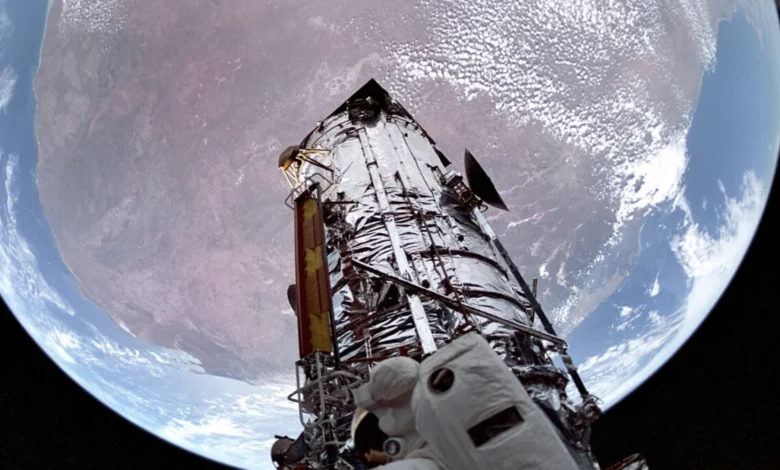
Since its deployment into low-Earth orbit in April 1990 aboard the Space Shuttle Discovery, the Hubble Space Telescope has served as humanity’s premier window into the cosmos. Over more than three decades of continuous operation, the observatory has captured some of the most scientifically groundbreaking and visually breathtaking imagery in the history of astronomy. From mapping the expansion rate of the universe to peering into the atmospheric composition of distant exoplanets, Hubble has fundamentally rewritten textbooks and inspired generations of scientists and space enthusiasts.
However, the twilight of this legendary observatory is drawing closer. Subject to the subtle yet relentless drag of Earth’s upper atmosphere, Hubble is on a slow, inevitable trajectory toward atmospheric re-entry. Current orbital models project that without intervention, the telescope will plunge back into Earth’s atmosphere sometime between 2033 and 2034. While much of the spacecraft would burn up during the fiery descent, unburned components could survive and potentially pose risks to populated regions on the surface.
Faced with constrained federal budgets and a diminishing internal capacity to service legacy orbital hardware, NASA has turned its gaze toward the burgeoning commercial spaceflight sector. Through a formally issued Request for Information (RFI) posted on government contracting portals, the space agency is officially soliciting concepts, technical proposals, and collaborative partnerships from private aerospace companies. The objective is twofold: either develop a method to physically boost Hubble to a safer, higher-altitude orbit that would extend its operational lifespan by decades, or design a precise, controlled de-orbit strategy to guide the spacecraft safely down into a remote ocean graveyard.
The Technical Challenge of Orbit Raising
Executing a successful service or re-boost mission for Hubble is an extraordinary engineering hurdle. Unlike the International Space Station, which routinely receives orbital boosts from docked cargo craft, Hubble was not originally designed for autonomous or commercial docking. Furthermore, the telescope currently orbits at an altitude of approximately 335 miles (540 kilometers). According to NASA’s specifications, raising the observatory to a significantly higher orbit—requiring an ascent of more than 370 miles (600 kilometers)—would push current in-space robotics and vehicle capabilities to their limits.
The last time Hubble received human intervention was in May 2009 during Space Shuttle mission STS-125 (Hubble Servicing Mission 4). During that flight, astronauts aboard the Space Shuttle Atlantis installed new batteries, gyroscopes, and scientific instruments while repairing others. Since the retirement of the Space Shuttle fleet in 2011, NASA has lacked a human-rated or robotic platform capable of reaching Hubble’s specific orbital inclination and altitude to perform maintenance or re-boosting tasks.
Today’s commercial aerospace companies, however, operate in a vastly different technological landscape compared to the early 2000s. Driven by the rapid commercialization of low-Earth orbit, private firms have developed advanced autonomous rendezvous and docking technologies, sophisticated robotic arms, and reusable heavy-lift launch vehicles that could theoretically make a robotic servicing mission feasible.
A New Era of Public-Private Collaboration
NASA leadership has expressed cautious optimism regarding the capabilities of the modern private space sector. Nicky Fox, associate administrator for the Science Mission Directorate at NASA, highlighted the rapid evolution of commercial in-space capabilities in an official agency statement.
"Commercial industry has rapidly evolved in recent years to offer new capabilities for in-space satellite capture and servicing," Fox stated. "Given the time we have until Hubble’s anticipated re-entry, we are eager to explore the breadth of possibilities to boost Hubble to a higher orbit while we develop the flagship mission to follow."
This sentiment was echoed by agency officials who emphasize a fiduciary and ethical duty to maximize the scientific return of taxpayer-funded infrastructure. The RFI has already drawn considerable attention from major industry players. Companies such as Elon Musk’s SpaceX—which previously assisted NASA in returning stranded astronauts Suni Williams and Butch Wilmore from the International Space Station using the Dragon spacecraft—and Peter Beck’s Rocket Lab, known for pioneering rapid-cadence launch solutions and mid-air rocket retrieval techniques, are seen as prime candidates to answer the call.
In late 2022, NASA and SpaceX even signed a non-funded Space Act Agreement to study the feasibility of a private mission to re-boost Hubble using a Falcon 9 rocket and a modified Dragon capsule, though a formal contract has not yet been awarded. The current RFI expands that exploratory mindset, inviting a wider array of proposals from across the entire global commercial space market.
A Chronological Look at Hubble’s Lifespan and Decline
Understanding the urgency of NASA’s initiative requires looking back at the telescope’s eventful historical timeline:
- April 24, 1990: Space Shuttle Discovery launches on mission STS-31, successfully deploying the Hubble Space Telescope into low-Earth orbit.
- December 1990: Scientists discover a flaw in Hubble’s primary mirror, resulting in spherical aberration that distorts its initial images.
- December 1993: NASA launches Space Shuttle Endeavour on STS-61, the first servicing mission, successfully installing corrective optics that grant Hubble its legendary sharp vision.
- February 1997: Servicing Mission 2 (STS-82) upgrades Hubble’s scientific instruments.
- December 1999: Servicing Mission 3A (STS-103) occurs after multiple gyroscope failures threaten to shut down the observatory.
- March 2002: Servicing Mission 3B (STS-109) aboard Space Shuttle Columbia installs new solar arrays and the Advanced Camera for Surveys, significantly boosting the telescope’s capabilities.
- May 2009: The final servicing mission (STS-125, Atlantis) upgrades the telescope, installing the Wide Field Camera 3 and the Cosmic Origins Spectrograph, extending its projected life into the 2020s.
- July 2011: The final Space Shuttle mission lands, officially ending NASA’s internal human capability to reach and service the telescope.
- December 2021: The James Webb Space Telescope (JWST) launches, taking over the mantle of flagship infrared space observatory, while Hubble continues its vital work primarily in ultraviolet and optical wavelengths.
- Present Day: Atmospheric drag steadily pulls the telescope downward, prompting NASA to issue Requests for Information to commercial partners to save or safely de-orbit the spacecraft before 2033.
Broader Implications for Space Exploration and Orbital Sustainability
The predicament facing the Hubble Space Telescope underscores a broader, growing challenge in modern space exploration: the management and sustainability of aging orbital infrastructure. As low-Earth orbit becomes increasingly congested with commercial mega-constellations, operational satellites, and space debris, the management of legacy spacecraft is shifting from a purely governmental concern to an international logistical puzzle.
If a commercial partner successfully demonstrates the capability to capture, service, and re-boost a non-cooperative, legacy spacecraft like Hubble, it could establish a revolutionary precedent. Such a mission would not only grant Hubble a potential second lease on life—allowing it to operate alongside the James Webb Space Telescope and the upcoming Nancy Grace Roman Space Telescope—it would also validate a commercial market for active debris removal and in-space satellite servicing.
For the scientific community, saving Hubble represents the preservation of a unique multi-decade baseline of ultraviolet and optical data that cannot be easily replicated. Long-term astronomical monitoring programs, such as tracking variable stars, distant supernovae, and the atmospheric changes of outer planets in our solar system, rely heavily on Hubble’s unbroken operational continuity.
As NASA reviews the submissions gathered through its commercial RFI, the fate of the world’s most famous telescope hangs in the balance. Whether Hubble is ultimately granted a high-altitude reprieve by a private spacecraft or guided downward into a controlled oceanic splashdown, its legacy as a cornerstone of modern astrophysics is already secure. However, the coming years will determine whether humanity’s ingenuity can extend the lifespan of an icon, proving that the commercial space age can successfully bridge the gap between yesterday’s pioneering technology and tomorrow’s frontier.