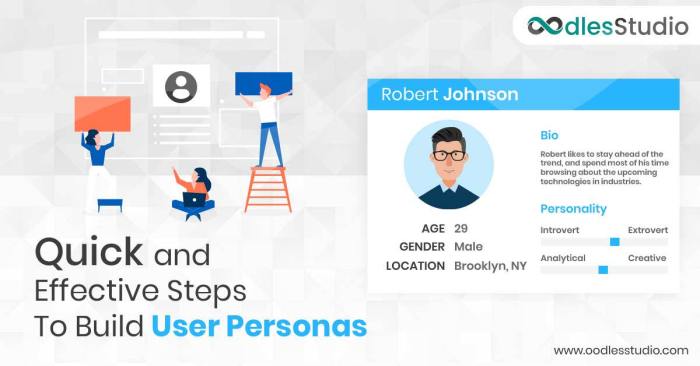

How to create user personas for your web design projects is a crucial step in designing effective and user-friendly websites. Understanding your target audience is paramount, and personas help you do just that. This guide dives deep into defining, researching, crafting, applying, iterating, visualizing, and utilizing tools for user personas. We’ll cover everything from understanding the core concept to creating actionable profiles and applying them throughout the design process.
This comprehensive guide will walk you through the entire process of developing user personas for your web design projects. We’ll explore different research methods, show you how to create detailed profiles, and demonstrate how to leverage those profiles to inform your design decisions, from initial wireframes to final testing. The goal is to empower you to create websites that truly resonate with your users.
Defining User Personas
User personas are fictional representations of your ideal customers. They go beyond simple demographics; they delve into the motivations, goals, and pain points that drive user behavior. Understanding these personas is crucial for designing effective websites and applications that resonate with your target audience. They help you anticipate user needs and tailor your design accordingly, leading to a more user-friendly and successful product.Understanding your users is fundamental to crafting a design that works.
Personas are not just about collecting data; they’re about using that data to create empathetic designs that solve real problems. They provide a shared understanding and common language among the design team, ensuring everyone is working towards the same goal of creating a product that meets user needs.
What are User Personas?
User personas are detailed profiles of your target users. They are more than just demographics; they encompass the user’s motivations, goals, and pain points. They are crucial for designing user-centered products and services, helping design teams anticipate and address user needs effectively.
Crafting user personas for your web design projects is key to understanding your audience. By delving into their needs and motivations, you can design a website that resonates deeply with them. This, in turn, allows you to stand out from the crowd and truly place yourself above your competition here. Ultimately, focusing on these detailed user profiles helps you build a truly exceptional online experience for your users.
User Personas vs. User Stories
While both user personas and user stories are vital for understanding users, they serve different purposes. User stories describe specific user goals and tasks, focusing on what a userwants* to do. Personas, on the other hand, provide a more comprehensive picture of the user, including their background, motivations, and pain points. This allows the design team to understand the “why” behind the user’s actions, leading to more empathetic and effective designs.
Best Practices for Creating Realistic and Actionable User Personas
Creating effective user personas requires a thoughtful approach. Start by gathering data from various sources, including user research, surveys, interviews, and existing customer data. Focus on creating personas that are both realistic and actionable, reflecting the diversity of your target audience.
- Involve diverse stakeholders: Gather input from different team members, including designers, developers, and marketers, to ensure a holistic understanding of user needs.
- Prioritize user needs: Focus on understanding the core needs, motivations, and goals of your users. Consider their frustrations and pain points.
- Develop detailed descriptions: Don’t just collect data; use it to paint a vivid picture of each persona. Include their background, demographics, motivations, and aspirations.
- Iterate and refine: User personas are not static documents. Continuously refine and update them based on new data and user feedback.
Key Components of a User Persona
A well-defined user persona includes several key components. These elements provide a comprehensive understanding of the user’s needs and motivations. This understanding allows designers to create more intuitive and user-friendly experiences.
| Component | Description | Example | Importance |
|---|---|---|---|
| Demographics | Age, gender, location, occupation, education level, and other identifying characteristics. | 35-year-old female, stay-at-home parent, lives in a suburban area, holds a bachelor’s degree in education. | Understanding basic characteristics to tailor the design to a specific audience. |
| Goals | What the user hopes to achieve through interaction with the product or service. | To easily manage their household budget, to quickly find recipes for healthy meals, to connect with friends and family. | Identifying the user’s intentions to craft features that support their goals. |
| Pain Points | Frustrations or challenges the user experiences when using existing products or services. | Difficulty navigating complex websites, lack of intuitive controls, inability to find specific information. | Understanding pain points to design solutions that address these issues. |
| Motivations | Reasons behind the user’s actions and choices. | Desire for convenience, need for efficiency, desire for social connection. | Identifying the drivers of user behavior to anticipate and fulfill their needs. |
Research Methods for Persona Development
Crafting compelling user personas hinges on robust research. Understanding your target audience’s needs, behaviors, and motivations requires gathering comprehensive data. This involves employing various research methods, each with its strengths and weaknesses. Careful consideration of your project’s specific goals and resources will help you choose the most effective approach.Effective persona development is crucial for creating targeted and user-centered designs.
By meticulously gathering insights through diverse research methods, you can gain a deep understanding of your users’ needs and behaviors, which will translate into more impactful and successful web design projects.
Choosing the Right Research Method
Choosing the appropriate research method is pivotal in persona development. Different methods offer varying levels of detail and insight, catering to diverse project requirements. Factors such as the project’s scope, budget, and available time frame play a crucial role in this decision-making process. Consider the depth of information needed, the accessibility of your target audience, and the resources available.
Creating user personas for your web design projects is crucial for success. Understanding your target audience’s needs, behaviors, and motivations is key, and a good starting point is examining how your ad spend breaks down. Things like “billed cost served cost adwords breakout” billed cost served cost adwords breakout can help reveal valuable insights into ad campaign performance and ultimately, better inform your user personas.
This knowledge will help you design a site that truly resonates with your users and meets their specific needs, leading to higher engagement and conversions.
For example, a small startup with limited resources might opt for surveys and existing data analysis, while a large corporation with ample resources might employ more in-depth methods like usability testing and in-person interviews.
Research Methods Overview
A variety of research methods are employed to gather data for user personas. Each method provides unique insights and should be chosen based on the project’s specific requirements.
- Surveys: Surveys are a cost-effective way to gather quantitative data from a large sample size. They allow for standardized questions and responses, enabling statistical analysis. Surveys are ideal for understanding broad trends and opinions within your target audience. For instance, a survey could help determine the preferred operating system of your users.
- Interviews: In-depth interviews provide qualitative data, revealing nuanced insights into user motivations and behaviors. They offer a valuable opportunity to probe deeper into user responses and gather rich, contextual information. For example, an interview with a potential user could reveal their pain points when navigating a website.
- Usability Testing: Usability testing involves observing users interacting with a website or prototype. This method helps identify areas of friction or confusion, revealing potential usability issues. Through usability testing, designers can pinpoint specific areas where the design could be improved. For example, a usability test could reveal that a particular button is too small for users to easily click.
- Existing Data Analysis: Leveraging existing data sources like website analytics (e.g., Google Analytics) and social media insights can provide valuable background information. Website analytics can reveal popular pages, bounce rates, and user engagement metrics. Social media analysis can offer insight into user conversations, interests, and preferences. For example, observing social media discussions about a competitor’s product could provide crucial information for informing your persona development process.
Comparative Analysis of Research Methods
The following table Artikels the advantages and disadvantages of different research methods:
| Research Method | Advantages | Disadvantages | When to Use |
|---|---|---|---|
| Surveys | Cost-effective, large sample size, quantifiable data | Limited depth of insight, superficial understanding, potential for bias | Understanding broad trends and opinions, gathering quantitative data for initial research |
| Interviews | Rich qualitative data, deep understanding of motivations, contextual insights | Time-consuming, expensive, smaller sample size, potential for interviewer bias | Uncovering nuanced insights, understanding user motivations, in-depth understanding of user behavior |
| Usability Testing | Identifies usability issues, observes user behavior in real-time, actionable insights | Can be costly, requires specific setup and training, time-consuming, limited sample size | Identifying areas of friction, assessing the effectiveness of prototypes, testing website designs |
| Existing Data Analysis | Cost-effective, readily available data, quick insights, identify trends | Limited context, potential for misinterpretation of data, may not provide sufficient detail | Initial research, understanding existing user behaviors, understanding user preferences |
Crafting Persona Profiles
Bringing your user research to life requires creating compelling user personas. These aren’t just lists of facts; they’re vivid representations of your target audience, allowing you to deeply understand their needs, motivations, and challenges. This section dives into the art of crafting effective personas that inform every design decision.A well-defined persona goes beyond basic demographics. It delves into the heart of the user, revealing their aspirations, fears, and the context in which they interact with your product or service.
This deeper understanding translates into designs that are truly user-centric.
Essential Elements of a Persona Profile
Understanding your target audience is crucial. A comprehensive persona profile encapsulates various facets of a typical user, ensuring a holistic view. This section details the essential elements to include.
- Name: A memorable name, reflecting the persona’s personality or role. Avoid generic names like “User A.” For example, “Sarah the Student” or “David the Digital Nomad.”
- Demographics: Age, gender, location, occupation, income, education level, family status. These provide a basic understanding of the user’s background. For example, Sarah the Student might be 20 years old, studying software engineering, and living in a university town.
- Background: This section details the persona’s life experiences and their relationship to the problem your product or service addresses. For example, David the Digital Nomad has been traveling for the last five years and relies on his laptop for work.
- Motivations: What drives this user? What are their goals and aspirations related to your product or service? For Sarah the Student, motivation could be finding efficient ways to manage her studies and workload.
- Goals: What specific outcomes does the persona hope to achieve by using your product or service? David the Digital Nomad’s goal might be to connect with remote work opportunities.
- Pain Points: What frustrations or challenges does the persona face that your product or service can alleviate? Sarah the Student might struggle with managing deadlines and prioritizing tasks.
- Technical Skills: What level of technical proficiency does the persona possess? Are they comfortable using complex software or do they prefer simpler tools? David the Digital Nomad might be proficient with cloud-based software but not necessarily with complicated software.
- Online Behavior: How does the persona use the internet? What are their preferred platforms, and how do they consume information? Sarah the Student might be active on social media for academic networking, but less engaged in forum discussions.
Example Persona Profile: Sarah the Student
This example demonstrates a complete persona profile, combining the essential elements.
- Name: Sarah the Student
- Demographics: 20 years old, female, lives in a university town, part-time job, middle-class income.
- Background: Enrolled in a software engineering program. Seeking to build a portfolio and gain practical experience.
- Motivations: Learn new technologies, build a strong portfolio, and improve time management skills.
- Goals: Secure an internship, develop a strong professional network, and gain valuable experience.
- Pain Points: Struggles with time management, prioritizing tasks, and keeping track of deadlines.
- Technical Skills: Proficient in basic programming languages, comfortable with cloud-based tools.
- Online Behavior: Active on social media for networking, uses online learning platforms, and seeks project ideas online.
Design Considerations Table
This table illustrates how understanding persona characteristics impacts design decisions.
| Persona Characteristic | Impact on Design Choices | Example Design Decision | Rationale |
|---|---|---|---|
| Sarah’s time management struggles | Prioritize a user-friendly interface with clear navigation and task management features. | Create a task list feature and a calendar integration. | Reduces the burden on the user by providing tools for efficient task management. |
| David’s need for remote work tools | Design a platform with seamless remote collaboration features. | Include screen-sharing, video conferencing, and file-sharing tools. | Supports David’s need for efficient communication and collaboration while working remotely. |
| Sarah’s online learning habits | Incorporate interactive tutorials and clear learning paths. | Provide interactive exercises and clear step-by-step guides. | Supports Sarah’s preferred learning style and encourages active participation. |
Applying Personas to Design Decisions: How To Create User Personas For Your Web Design Projects
User personas are more than just fictional characters; they’re powerful tools for shaping the design of your web project. By understanding the needs, motivations, and behaviors of your target users, you can make informed decisions at every stage of the design process. This leads to a more user-centered approach, resulting in a website or application that is not only aesthetically pleasing but also truly effective in achieving its goals.Integrating persona insights throughout the design process ensures the final product aligns closely with user expectations and requirements.
This iterative approach fosters a strong connection between the design team and the intended users, ultimately improving the overall user experience.
Understanding your target audience is key when creating user personas for your web design projects. Think about how your ideal client interacts with a website, and consider how their needs might differ from those of other potential clients. This process is directly connected to effective referral marketing and your professional services brand; referral marketing and your professional services brand often benefits from a strong understanding of your client base.
Ultimately, creating these detailed personas will help you craft a website that truly resonates with your ideal clients and converts them into loyal customers.
Guiding Design Decisions with Personas
Understanding your user personas allows you to anticipate their needs and preferences. This foresight is crucial in making informed design choices. For example, if your persona is a busy professional, the design should prioritize speed and efficiency. Conversely, a design for a family might emphasize ease of use and intuitive navigation for diverse members.
Incorporating Personas into Wireframing
Wireframes are the skeletal structure of your web project. User personas inform the layout, navigation, and placement of key elements. Consider a persona who frequently shops online. A well-organized layout, prominent search bar, and clear product categorization would be crucial elements of their wireframe. This demonstrates how a user’s behavior influences the structure of the website.
Prototyping with Persona Insights
Prototypes are interactive representations of your design. Use personas to guide the interactive elements. For example, if a persona frequently encounters errors on a site, the prototype should incorporate robust error handling and clear feedback mechanisms.
Persona-Driven Testing
User testing allows you to validate your design decisions against real user behavior. Use personas to guide your test scenarios. For instance, if your persona is a visually impaired user, the test scenarios should assess the website’s accessibility features.
Prioritizing Design Features
User personas aid in prioritizing features. A persona focused on productivity might prioritize features like task management and efficient workflows. A persona focused on entertainment might prioritize high-quality media and personalized recommendations. This prioritization ensures the design addresses the most critical needs of your target users.
Making Design Decisions Based on Personas
Making design decisions using personas requires a systematic approach. Here’s a framework:
- Identify the persona’s needs and goals: Understand their motivations and expectations. A user who values convenience will want simple navigation.
- Analyze the persona’s tasks and workflows: Map out how the persona interacts with the website or application. Consider their pain points and areas for improvement.
- Translate persona insights into design specifications: Convert user needs into actionable design decisions. For instance, if a persona needs to easily find information, incorporate clear labeling and intuitive navigation.
- Evaluate design decisions against persona characteristics: Assess if the design effectively addresses the needs and expectations of the target user. For instance, a persona who values speed might appreciate a fast loading time and efficient processes.
Applying Personas Across Design Stages
- Information Architecture (IA): Personas inform the structure and organization of information on the site, ensuring intuitive navigation that aligns with the persona’s needs. A persona focused on finding specific products would necessitate a well-organized product catalog.
- Usability Testing: Personas guide the selection of test subjects and scenarios, enabling the validation of design decisions against real user behavior. Testing with a persona who values security would evaluate the site’s security measures.
- Content Strategy: Personas inform the tone, style, and language of the website’s content, ensuring it resonates with the persona’s values and preferences. A persona interested in learning about a complex topic would benefit from detailed and comprehensive content.
- Visual Design: Personas guide the choice of colors, typography, and imagery, creating a visual experience that aligns with the persona’s aesthetic preferences. A persona who appreciates minimalist aesthetics would appreciate a clean and uncluttered design.
Iterating and Refining Personas

Personas are not static documents; they are dynamic representations of your users. Understanding that user needs and behaviors evolve is crucial for creating effective designs. Revisiting and refining your personas throughout the design process allows for adaptation and ensures your project remains aligned with the evolving needs of your target audience. This iterative approach guarantees a product that resonates with users and effectively addresses their needs.User feedback and data analysis are invaluable tools in refining user personas.
Regularly collecting feedback through various channels, such as surveys, interviews, and usability testing, provides insights into how users interact with the product and reveals any discrepancies between the initial persona assumptions and actual user behavior. Data analysis of user interactions, clickstream data, and usage patterns can further quantify these insights and pinpoint specific areas for improvement.
Incorporating Feedback into Persona Profiles
Gathering feedback requires a structured approach. Feedback should be categorized and analyzed to identify patterns and trends. The feedback should be analyzed in relation to the persona’s characteristics, motivations, and goals to understand how their actions reflect their needs and behaviors. This analysis helps pinpoint specific aspects of the persona that need adjustment, potentially revealing inconsistencies or unmet needs.
For example, if feedback consistently indicates difficulty using a particular feature, the persona’s profile should be updated to reflect this challenge.
Adapting Personas Based on Changing Needs
User needs and expectations change over time, influenced by societal shifts, technological advancements, and evolving personal circumstances. Market research and trends analysis are crucial in monitoring these shifts. Staying abreast of these changes is essential for maintaining the relevance of your personas. For instance, if a significant portion of your user base begins utilizing a new platform, the persona’s technology profile needs to be updated.
This ongoing monitoring ensures the personas remain accurate and effective.
Process for Persona Refinement
The process for persona refinement is cyclical. It starts with collecting user feedback, then analyzing the feedback to identify areas needing adjustment. Then, incorporate the adjustments into the persona profiles, and finally, test the product to see if the adjustments were successful. This cycle allows for a continuous feedback loop that refines personas based on user interactions and evolving needs.
User Feedback Categories and Persona Adjustments
| Feedback Category | Potential Persona Adjustment | Example Feedback | Impact on Design Decisions |
|---|---|---|---|
| Usability Issues | Refine tasks, improve interface design, adjust navigation | “The button was too small to click.” | Reduce button size, increase click target area, implement better visual cues |
| Frustrations | Identify pain points, adjust user flow, streamline processes | “I got lost in the process.” | Improve navigation, provide clear instructions, implement better signposting |
| Unmet Needs | Clarify motivations, expand goals, include new tasks | “I needed a way to share this information.” | Add sharing functionality, incorporate social media integration |
| Unexpected Behaviors | Update behaviors, adapt motivations, adjust goals | “Users frequently skip step X.” | Re-evaluate the importance of step X, consider alternative approaches |
Visualizing User Personas
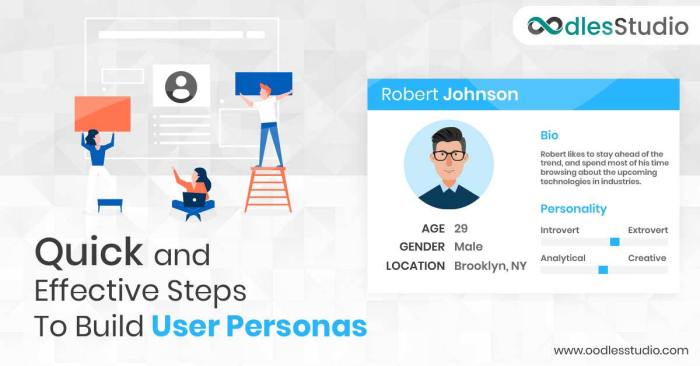
Bringing user personas to life goes beyond simply listing their characteristics. Visual representations make them more memorable and engaging, facilitating better understanding and buy-in from stakeholders. A well-crafted visual persona can quickly communicate complex insights and inspire more empathetic design decisions.Visual representations are crucial for making personas accessible and easily understandable to everyone involved in the design process, including those who might not be deeply immersed in the research phase.
This enhanced clarity fosters shared understanding and agreement on the user needs and behaviors.
Visual Representation Methods
Visual representations can take many forms, each with its own strengths and weaknesses. Choosing the right method depends on the specific information you want to highlight and the audience you’re trying to reach. Visualizations can be as simple as sketches or as elaborate as detailed user journey maps, each offering a unique perspective on user needs and behaviors.
- Sketches: Simple sketches can effectively capture the essence of a persona. A quick sketch of a persona’s environment, or a depiction of their daily routine, can immediately convey important details. For example, a sketch of a young professional using a laptop in a brightly lit co-working space quickly communicates the persona’s likely needs and work environment.
- Infographics: Infographics condense key persona characteristics into easily digestible visuals. These can include charts, graphs, or icons that represent key data points such as age, location, and interests. A good infographic might illustrate the frequency of website visits by a specific persona segment, using a bar graph to represent the volume of interaction.
- User Journey Maps: These maps visualize the steps a user takes to achieve a goal, highlighting pain points and opportunities for improvement. A user journey map might illustrate a user’s experience when attempting to complete a purchase on an e-commerce website, showcasing where the user might encounter friction or confusion.
- Character Illustrations: A more detailed character illustration can create a stronger sense of personality and relatability for a persona. This method might use stylized visuals to represent the persona’s physical appearance, attire, and even their emotional state.
Examples of Visual Representations
A basic persona representation might use a simple image to illustrate a user’s age and gender. A more advanced example could use an infographic to display their technical skills, alongside a user journey map depicting their experience with a specific software application. Consider a scenario where an e-commerce website is being designed. Visual representations could include a user journey map that shows a shopper browsing products, adding items to their cart, and then navigating the checkout process, thereby highlighting potential issues or pain points in the process.
Communicating Persona Insights to Stakeholders, How to create user personas for your web design projects
Visual representations are essential for effectively communicating persona insights to stakeholders. They facilitate easier comprehension and shared understanding of user needs and behaviors. A visually compelling presentation, featuring user journey maps and infographics, can quickly capture the attention of decision-makers and influence design decisions. For instance, a presentation focused on a specific persona segment, illustrating their pain points and needs, can lead to focused design solutions.
Visual Persona Visualization Methods Table
| Visualization Method | Strengths | Weaknesses | Use Cases |
|---|---|---|---|
| Sketches | Quick, easy to create, conveys basic information | Less detailed, may not be suitable for complex personas | Initial persona brainstorming, quick visualizations for meetings |
| Infographics | Concise, easily digestible, highlights key data points | Can be overly simplistic, may miss nuanced details | Presenting overall persona characteristics, highlighting user demographics |
| User Journey Maps | Visualizes user flow, identifies pain points, showcases opportunities | Can be time-consuming to create, may require detailed user research | Understanding user experience, optimizing workflows, improving customer satisfaction |
| Character Illustrations | Creates relatability, builds emotional connection with persona | Can be time-consuming to develop, may not be suitable for all situations | Visualizing the emotional side of a user, emphasizing human aspects |
Tools and Resources for Persona Development
Crafting compelling user personas relies heavily on effective research and analysis. Choosing the right tools and resources can significantly streamline this process, ensuring your personas are accurate and insightful. The variety of available tools allows you to collect, analyze, and synthesize data from various sources, providing a richer understanding of your target audience.Leveraging the right tools empowers you to gather detailed information about user needs, behaviors, and motivations.
This data-driven approach ensures your personas are grounded in reality, not assumptions, leading to more effective design decisions. The proper selection of tools allows for a more structured and efficient process of persona development.
Survey Platforms
Surveys are invaluable for gathering quantitative data about your target audience. They provide a structured method to understand user preferences, behaviors, and opinions. Choosing a platform that allows for customization and analysis is key.
- Google Forms: A free and widely accessible option for creating and distributing surveys. Its ease of use and integration with other Google tools makes it a popular choice for basic survey needs. It’s particularly helpful for gathering feedback on specific features or aspects of your product or service.
- SurveyMonkey: A more robust platform with advanced features like branching logic and detailed reporting. It’s a good option for more complex surveys requiring in-depth analysis. It provides detailed reports and allows for testing different versions of your survey to ensure optimal responses.
- Typeform: Known for its visually appealing and user-friendly interface, Typeform is suitable for creating engaging surveys. Its intuitive design helps improve response rates and makes the survey experience more enjoyable for participants. Its features for custom branding and advanced analytics are also attractive.
User Research Software
Beyond surveys, user research software offers a broader range of tools for gathering and analyzing qualitative data. These platforms allow you to conduct user interviews, record observations, and analyze user feedback, providing rich insights into user behavior and motivations.
- UserTesting: This platform specializes in remote user testing, allowing you to observe users interacting with your website or app in real-time. It’s valuable for understanding how users navigate and engage with your product. It also provides insights into user frustrations and pain points.
- Lookback: Designed for usability testing, Lookback provides a platform for recording and analyzing user interactions with your product. It’s ideal for understanding user behavior patterns and identifying areas where users struggle. It facilitates the process of gathering qualitative data and identifying usability issues.
- UserZoom: A comprehensive user research platform with a range of tools, including remote usability testing, surveys, and focus groups. Its versatility allows for a holistic approach to gathering data and insights into user needs. It excels in handling large-scale user research projects.
Other Useful Tools
Other tools can be incorporated to enhance the persona development process.
- Heatmaps and Click Tracking Tools (Hotjar, Mouseflow): These tools allow you to visually represent user behavior on your website, providing valuable data on where users are clicking, scrolling, and spending time. This data helps understand user engagement patterns and identify areas needing improvement.
- Social Media Analytics Tools (Hootsuite, SproutSocial): Understanding your target audience’s online presence on social media is crucial. These tools provide insights into their interests, activities, and conversations, allowing you to tailor your personas to reflect these aspects of their online behaviour.
Tool Comparison Table
| Tool | Features | Pros | Cons |
|---|---|---|---|
| Google Forms | Simple surveys, data export | Free, easy to use, integrates with Google ecosystem | Limited features, basic analytics |
| SurveyMonkey | Advanced surveys, reporting, branching logic | Robust features, detailed reports, good for complex surveys | Paid, learning curve for advanced features |
| UserTesting | Remote user testing, video recordings, feedback | Direct observation of user behavior, insights into usability issues | Requires setup and coordination, cost can vary |
| Lookback | Usability testing, heatmaps, recordings, user feedback | Detailed usability insights, intuitive interface | Can be expensive, limited features compared to more comprehensive platforms |
Last Recap
In conclusion, crafting user personas is an essential step in web design. By understanding your target audience, you can design websites that meet their needs and preferences. This guide has provided a detailed roadmap for developing compelling personas and applying them to your projects. Remember, the key is to continually iterate and refine your personas as you gather more user feedback and data.
This ensures your designs stay aligned with user needs and preferences, ultimately creating a successful and satisfying user experience.