


How to add a smooth scroll to top effect in WordPress using jQuery sets the stage for a fascinating exploration of enhancing user experience on your website. This guide dives deep into the technical aspects, from basic HTML structure to advanced jQuery implementation, and WordPress integration. Learn how to create a seamless and engaging scroll-to-top feature that will keep visitors returning.
We’ll cover everything from simple jQuery code snippets to customizing the animation, adding visual cues, and ensuring a responsive design. You’ll also find insights into advanced features, like scrolling to specific elements, handling multiple triggers, and optimizing performance. Troubleshooting and accessibility considerations are included, making this a comprehensive guide for creating a polished, user-friendly WordPress website.
Introduction to Smooth Scroll to Top
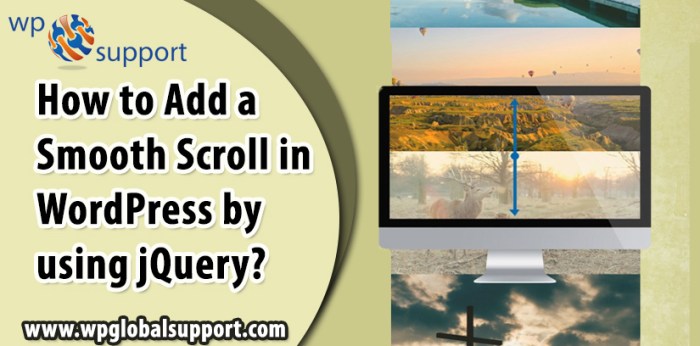
Smooth scrolling to the top is a user interface technique that provides a more engaging and refined user experience compared to abrupt, instantaneous jumps. Instead of a jarring, immediate transition, smooth scrolling gradually moves the user’s view to the top of the page, often with a subtle animation. This creates a more pleasant and user-friendly interaction, particularly on longer web pages.This refined experience enhances user satisfaction by offering a seamless transition, avoiding the abrupt and sometimes disorienting effect of traditional scrolling.
The gradual movement provides a smoother visual cue, allowing users to anticipate their arrival at the top of the page. It’s a subtle but significant improvement in user experience design.
Want to add a smooth scroll-to-top effect to your WordPress site using jQuery? It’s surprisingly easy! You can find tons of helpful tutorials online. Speaking of helpful, did you know that Google Bard can now use your device’s location? This new feature might be interesting for location-based searches or interactions. Regardless, a smooth scroll-to-top is a great user experience enhancement for any WordPress site, and jQuery makes it super simple to implement.
Benefits of Smooth Scrolling
Smooth scrolling improves the overall user experience by creating a more aesthetically pleasing and intuitive navigation method. This gradual movement creates a more sophisticated and modern feel. It enhances the perception of page responsiveness, contributing to a better overall user impression. By reducing the jarring effect of sudden jumps, smooth scrolling leads to a more positive and seamless user interaction.
jQuery for Smooth Scrolling in WordPress
jQuery provides a versatile and efficient way to implement smooth scrolling in WordPress. It simplifies the process of adding this feature, making it accessible even for developers with less experience. Its extensive library of functions and its widespread use in the WordPress community make it a practical choice. It provides a readily available, well-documented, and well-supported solution, minimizing potential development challenges.
HTML Structure for Smooth Scrolling
The HTML structure for smooth scrolling generally requires a dedicated element for the scroll-to-top functionality. This could be a button or a link that, when clicked, triggers the smooth scrolling effect. A common approach is to use an anchor tag with an `id` attribute. This id, or its corresponding link, is used to specify the target destination for the smooth scroll.
- An anchor element, ideally a button or link, is crucial for initiating the scroll. It’s crucial for smooth interaction and is a cornerstone of smooth scroll functionality.
- The anchor element’s `href` attribute should point to the desired target location on the page. Using the `#` symbol followed by the ID of the target element ensures a smooth transition to the specified point.
- The target location should be an element with a unique `id` attribute. This `id` is linked to the anchor element to trigger the smooth scroll effect.
Example: Scroll to Top
This example demonstrates a simple link that will smooth-scroll the user to the element with the ID “top”. The use of the `#` symbol directs the browser to the target element. Note that IDs are unique to a document, so multiple elements cannot share the same ID.
jQuery Code Implementation
Adding a smooth scroll-to-top functionality enhances user experience on your WordPress site. This section dives into the practical implementation using jQuery, covering crucial aspects like attaching the script, handling diverse scroll speeds, and accommodating various trigger elements. We’ll also address edge cases, ensuring a seamless user journey.Implementing a smooth scroll to the top is a valuable addition to any website, and jQuery provides an efficient way to achieve this.
A well-designed scroll-to-top functionality not only improves usability but also contributes to a more polished and professional look.
Basic jQuery Code Snippet
A fundamental jQuery code snippet for smooth scrolling is essential. This snippet acts as the core of the functionality, facilitating smooth transitions between sections.“`javascript$(document).ready(function() $(“#scroll-to-top”).click(function(event) event.preventDefault(); $(“html, body”).animate( scrollTop: 0 , “slow”); ););“`This code snippet listens for clicks on an element with the ID “scroll-to-top.” It prevents the default link behavior and animates a smooth scroll to the top of the page.
The `animate` function handles the transition.
Attaching the Script to a Specific Element
Attaching the script to a specific element is crucial for targeting the desired action. This element will be the trigger for the smooth scroll.The example above uses a button with the ID “scroll-to-top.” Other elements, like an image or a link, can also be used. Adapting the code to use a different element is straightforward by changing the selector (`$(“#scroll-to-top”)`) to target the desired element.
Incorporating the Script into the WordPress Theme
Integrating the jQuery code into your WordPress theme requires careful placement. Ideally, it should be included in a JavaScript file.
- Create a new JavaScript file (e.g., `smooth-scroll.js`) in your theme’s `js` directory.
- Place the jQuery code snippet within this file.
- Include the JavaScript file in your theme’s `functions.php` file, or a specific page template. Use the `wp_enqueue_script` function to correctly load the file.
“`phpfunction my_theme_enqueue_scripts() wp_enqueue_script( ‘smooth-scroll’, get_template_directory_uri() . ‘/js/smooth-scroll.js’, array( ‘jquery’ ), ‘1.0’, true );add_action( ‘wp_enqueue_scripts’, ‘my_theme_enqueue_scripts’ );“`This ensures the script loads correctly within your WordPress environment.
Handling Different Scroll Speeds, How to add a smooth scroll to top effect in wordpress using jquery
Adjusting the scroll speed is vital for creating a custom user experience. The `animate` function allows for precise control.The `”slow”` value in the `animate` function (e.g., `$(“html, body”).animate( scrollTop: 0 , “slow”);`) is a preset animation speed. You can use other predefined speeds like `fast` or specify a custom duration in milliseconds.“`javascript$(“html, body”).animate( scrollTop: 0 , 500); //Scrolls in 500 milliseconds“`
Using Various Scroll Trigger Elements
The scroll-trigger element can be diverse. It’s about associating the smooth scrolling action with a specific element, such as a button, a link, or even an image.A common trigger element is a button. Links can also act as triggers. For instance, a button with the ID “scroll-to-top” can be linked to the smooth scrolling action.“`javascript$(“#my-button”).click(function() $(“html, body”).animate( scrollTop: 0 , 750); //Adjusting speed);“`This demonstrates how to use a button as a trigger, achieving smooth scrolling with a 750-millisecond duration.
Using the jQuery animate() Function
The `animate()` function is central to smooth scrolling. It allows for controlled transitions. This is critical for creating the seamless effect.The `animate()` function in jQuery smoothly transitions elements to a specified destination. Its use is crucial for creating a user-friendly experience. Adjusting the animation duration (e.g., 500 milliseconds) fine-tunes the scrolling speed.
Handling Edge Cases
Edge cases, such as the user already being at the top of the page, require specific handling. The code should gracefully manage these situations.“`javascript$(document).ready(function() $(“#scroll-to-top”).click(function(event) event.preventDefault(); if ($(window).scrollTop() === 0) return; //Do nothing if already at the top $(“html, body”).animate( scrollTop: 0 , “slow”); ););“`This refined code checks if the user is already at the top.
If they are, it prevents unnecessary animations.
WordPress Integration
Integrating jQuery for the smooth scroll-to-top effect in WordPress involves careful consideration of plugin methods, theme modifications, and best practices. Proper implementation ensures the functionality works seamlessly without impacting other website elements. A well-structured approach is key to maintaining a clean and efficient website.
Plugin Methods for Adding jQuery
Several WordPress plugins can facilitate the inclusion of jQuery. These plugins often offer various functionalities beyond just adding libraries, so choosing the right one depends on your specific needs. Some popular plugins handle JavaScript management directly, while others might focus on specific features like page builders or custom functionalities. Carefully assess the plugin’s documentation to understand how it handles jQuery integration.
Adding jQuery to functions.php
Modifying your WordPress theme’s `functions.php` file is another method. This approach gives you granular control over the jQuery integration process, but it necessitates careful consideration to avoid conflicts with other scripts. Placing the code in the correct location is crucial to ensure proper loading order and functionality.
Importance of Using a Child Theme
Using a child theme is highly recommended when making modifications to your WordPress theme. This approach prevents unintended consequences if you need to update the parent theme or if you want to revert your changes in the future. A child theme allows you to customize the theme without affecting the original codebase, preserving its integrity and functionality.
Adding the jQuery Script to Header or Footer
Placing the jQuery script in the header or footer has implications for the loading order of scripts. Loading in the header ensures that jQuery is available for all elements on the page, which is often the preferred choice for smooth scroll-to-top functionality. However, placing it in the footer may be appropriate for specific situations where loading the script is not crucial for initial page rendering.
Common Pitfalls and Troubleshooting
Potential issues might arise due to conflicts with other plugins or incorrect script placement. Carefully examine your theme’s structure, and ensure the jQuery code is integrated appropriately. Checking browser developer tools for errors can identify the source of problems, while thorough testing in different browsers is crucial to avoid unexpected behaviors.
Including External Libraries
Integrating advanced features often requires external libraries. For instance, if you need specific animation or scrolling effects, you might need to include additional libraries. Carefully review the documentation for the external library to ensure compatibility with your theme and other plugins. Follow the library’s instructions for inclusion, ensuring the loading order and dependencies are correctly handled.
Best Practices for jQuery Management in WordPress
Using a dedicated plugin or directly modifying `functions.php` offers control. Ensure the jQuery library is loaded only once. This prevents redundancy and potential conflicts. Employing a child theme safeguards your modifications, enabling easier updates or reversions. Thorough testing in various browsers and scenarios is essential to ensure compatibility and reliability.
Customizing the Scroll Effect
Adding a smooth scroll-to-top effect is just the beginning. Beyond the basic functionality, there’s a world of customization available to tailor the experience to your website’s unique design and user needs. This section delves into various options for modifying the animation, visual cues, and button styles, making the effect truly your own.
Adjusting Animation Duration
The animation duration dictates how long the scroll takes to complete. A shorter duration makes the effect quicker, while a longer duration provides a more deliberate, considered experience. Adjusting this value is straightforward, modifying the `duration` parameter in the `animate()` function. For instance, to make the scroll take 800 milliseconds, you would change the line of code from `$(‘html, body’).animate(scrollTop: 0, 500);` to `$(‘html, body’).animate(scrollTop: 0, 800);`.
This allows you to precisely control the pace of the scroll animation.
Altering the Easing Function
The easing function controls theshape* of the animation, determining how the scroll accelerates and decelerates. Different easing functions produce distinct visual experiences. jQuery offers various easing options, such as `linear`, `swing`, `easeInQuad`, `easeOutExpo`, and many others. For a smooth and natural feel, `swing` is often a good default choice, but `easeOutExpo` provides a more pronounced deceleration effect, which could be suitable for a more sophisticated feel.
You can find examples of various easing functions in the jQuery documentation.
Adding Visual Cues During Scrolling
Visual cues during scrolling can enhance user awareness and provide a more engaging experience. This can include a subtle visual effect such as a fading overlay or a progress bar, or even a simple loading animation to signal the process. These visual aids can make the scroll-to-top action more interactive and give the user a sense of progress.
Implementing a Custom Button
A custom button allows for greater design control and a more integrated aesthetic. You can create a button element with a custom class and style it with CSS. Then, link the button’s click event to the smooth scroll-to-top functionality. This approach lets you incorporate the button seamlessly into the website’s design, whether it’s a fixed button at the bottom or a floating element.
Incorporating Different CSS Styles
Styling the scroll effect with CSS is crucial for ensuring consistency with the website’s overall design. Use CSS to adjust the button’s color, size, and position, or style the visual cue overlay. You can apply custom colors, fonts, and shapes to the scroll effect elements to achieve a cohesive visual identity. Remember that responsiveness is key to ensuring a consistent user experience across different devices.
Ensuring Responsiveness
Responsiveness is critical for a positive user experience across different screen sizes. Adjust the button’s size, position, and visual cues based on screen width to maintain clarity and usability on mobile devices and smaller screens.
Comparing Animation Effects
Different animation effects can create various user experiences. A `linear` effect offers a consistent speed, while an `easeOutExpo` effect emphasizes the deceleration phase, creating a more polished look. Choosing the appropriate effect depends on the overall aesthetic and desired user interaction with the scroll-to-top feature. Experiment with various easing functions to find the effect that best aligns with your website’s design and user expectations.
Advanced Scroll Effects
Adding smooth scrolling to a WordPress site is a great way to enhance the user experience, but true power comes from extending this functionality to more complex scenarios. This section delves into advanced techniques for creating dynamic and user-friendly scrolling experiences, such as targeting specific elements, managing pagination, and handling multiple triggers on a single page. We’ll explore how to prevent conflicts with other plugins and tailor the scroll speed for a more refined user interaction.Smooth scrolling isn’t limited to just the top of the page.
This expanded functionality allows for a more engaging experience, where users can easily navigate to specific content within the site, making the site feel more responsive and intuitive.
Smooth Scroll to a Specific Element
Targeting a particular element on the page, rather than just the top, is a valuable enhancement to a smooth scroll implementation. Using jQuery, you can pinpoint a specific ID or class, directing the user directly to that element. This functionality is crucial for improving user navigation. This is especially important on long pages or when there are distinct sections.
Scroll to a Particular Section
Implementing smooth scrolling to specific sections is a key aspect of enhancing site navigation. Using jQuery, you can create a seamless transition between sections. This method typically involves associating smooth scrolling functionality with links that target these sections. This is accomplished by using unique IDs or classes associated with the target sections on the page.
Incorporating Pagination with Smooth Scrolling
Pagination is a common way to organize content, and smooth scrolling can be integrated seamlessly. When combined with pagination, the smooth scroll effect provides a more polished user experience, facilitating easy navigation between pages of content. This is commonly seen on blogs and websites with extensive content. This feature allows users to move between pages without losing their place, maintaining a consistent and enjoyable experience.
Handling Multiple Scroll Triggers
In situations with multiple scroll triggers on a single page, careful handling is necessary to avoid conflicts. Each trigger needs a unique selector, and the smooth scrolling functions should be organized to prevent interference. Using event delegation or chaining functions can help manage multiple triggers without causing conflicts.
Preventing Conflicts with Other Plugins/Scripts
Conflicts between plugins or scripts are a potential issue when adding custom JavaScript. Thorough testing and careful consideration of event handling and selectors are essential to avoid conflicts with other functionalities. A comprehensive understanding of how other scripts interact on the page can mitigate conflicts. Checking for potential naming conflicts and carefully managing event listeners can help resolve these issues.
Code Examples for Multiple Sections
“`javascript// Example for multiple sections$(document).ready(function() $(‘a[href^=”#”]’).on(‘click’, function(event) event.preventDefault(); var target = $(this.getAttribute(‘href’)); if (target.length) $(‘html, body’).animate( scrollTop: target.offset().top , 1000); ););“`This code example demonstrates smooth scrolling to various sections using unique IDs.
By utilizing jQuery’s `animate` method, the scroll transition becomes smooth and user-friendly.
Handling Different Scroll Speeds, How to add a smooth scroll to top effect in wordpress using jquery
Tailoring the scroll speed to specific elements can enhance the user experience. Adjusting the `duration` parameter in the `animate` method allows for varying speeds depending on the element being targeted. For example, you can have a faster scroll for short sections and a slower scroll for more significant sections, resulting in a more customized experience.
Error Handling and Troubleshooting
Smooth scrolling to the top, while often seamless, can sometimes encounter hiccups. Understanding potential errors and how to diagnose them is crucial for maintaining a smooth user experience. This section details common issues, troubleshooting steps, and preventive measures to ensure your smooth scroll implementation works flawlessly in your WordPress site.Proper error handling ensures your smooth scroll function doesn’t break the user experience.
This section addresses various issues that might arise, from simple jQuery errors to conflicts with other plugins.
Figuring out how to add a smooth scroll-to-top effect in WordPress using jQuery is a pretty straightforward process. You’ll need to understand a bit about jQuery’s animation capabilities, and, to really optimize your site’s performance, consider the impact of your marketing efforts on your bottom line. For example, accurately measuring the true cost of marketing initiatives, like the ones outlined in measuring the true cost of marketing , is crucial.
This is important to factor in when evaluating the return on investment of your WordPress site’s design choices, like the smooth scroll-to-top feature.
Common jQuery Errors in WordPress
Incorrect jQuery library inclusion or conflicts with other scripts are common causes of smooth scroll problems. Ensure you’re using the correct version of jQuery and that it’s properly loaded before your smooth scroll script. A crucial step is verifying that your smooth scroll JavaScript code is placed correctly within your WordPress theme’s files, or a plugin’s, ensuring that it’s not overwritten or interfered with by other plugins.
Diagnosing Smooth Scroll Issues
Identifying the source of the problem is often the first step in resolving it. A systematic approach is key to efficiently pinpoint the source of any issues.
- Verify jQuery Loading: Check if jQuery is correctly enqueued and loaded in your WordPress theme or plugin. Inspect the browser’s console for any error messages related to jQuery loading. This is a vital first step to rule out fundamental problems.
- Inspect the Console: Use your browser’s developer tools (often accessed by pressing F12) to view the browser console. Errors, warnings, and messages related to your smooth scroll JavaScript will be displayed there. Pay close attention to the error messages and their context to pinpoint the source of the problem.
- Check JavaScript Syntax: Double-check your smooth scroll JavaScript code for typos, incorrect syntax, and missing semicolons. Carefully review the code to identify and rectify any syntax-related errors. These errors are often subtle but can cause significant problems.
- Test with a Minimal Setup: Create a test page with only the essential code for your smooth scroll. This isolates the smooth scroll functionality from other elements, enabling you to determine whether the problem lies within your smooth scroll implementation or other parts of your website.
Preventing Conflicts with Other Plugins
Conflicts with other plugins are another common cause of smooth scroll issues. Careful plugin management is vital to ensure compatibility.
- Plugin Compatibility: Carefully review the documentation for any plugins that might interact with your smooth scroll script. Examine if the plugin’s code might be interfering with the smooth scroll functionality.
- De-activating Plugins: Temporarily deactivate other plugins to isolate potential conflicts. This helps determine if any particular plugin is causing the issue.
- Plugin Updates: Keep your plugins updated to ensure compatibility with other scripts and functionalities, including smooth scrolling. This is a vital step in preventing compatibility issues.
Adding Console Logging for Debugging
Adding console logs can greatly assist in understanding the flow of execution and identifying the source of the problem.
- Strategic Logging: Strategically insert console.log statements into your smooth scroll JavaScript code to track the values of variables, the execution flow, and the interactions between different parts of your code. This allows you to trace the path your smooth scroll function takes and pinpoint the exact step causing the problem.
- Inspect Log Messages: Carefully inspect the console log messages. These messages provide detailed information about the execution path, including the values of variables at various points, helping pinpoint the exact location of the error.
Handling Unexpected Behavior
Unexpected behavior can occur for various reasons.
- Review CSS Styling: Ensure that your CSS styles are not conflicting with your smooth scroll implementation. Verify that your CSS rules aren’t interfering with the expected behavior of your smooth scroll functionality.
- Examine DOM Structure: Check that the elements involved in your smooth scroll are structured as expected and that the jQuery selectors are accurately targeting the desired elements. Ensure your DOM structure is consistent with your jQuery code to avoid unexpected behaviors.
- Retry with a Fresh Installation: In some cases, a complete reset of your smooth scroll implementation might be required. Re-installing the smooth scroll code from scratch can help isolate any problems.
Responsive Design Considerations: How To Add A Smooth Scroll To Top Effect In WordPress Using Jquery

Making your smooth scroll-to-top button truly user-friendly involves ensuring it adapts seamlessly to various screen sizes. A responsive design is crucial for a positive user experience across desktops, tablets, and smartphones. Ignoring responsiveness can lead to a frustrating experience, especially for users on smaller screens where the button might be hidden or difficult to click.Implementing responsive design principles ensures that the scroll-to-top button remains visible, accessible, and functional regardless of the device or screen size.
This is achieved by using media queries to adjust the button’s styling and positioning according to the screen width. Understanding how different screen sizes impact the layout and incorporating media queries into the code are key to a smooth user experience across various devices.
Media Query Implementation
Employing media queries is the standard approach for achieving responsiveness. These CSS rules apply different styles based on the screen’s width. This allows you to tailor the button’s appearance and position for optimal viewing and usability on various devices.
The following example demonstrates how to use media queries to adjust the button’s size and positioning for smaller screens:
“`CSS/* Styles for larger screens (e.g., desktops) – /#scroll-to-top display: block; position: fixed; bottom: 20px; right: 20px; width: 50px; height: 50px; background-color: #333; border-radius: 50%; cursor: pointer;/* Styles for smaller screens (e.g., tablets and smartphones) – /@media (max-width: 768px) #scroll-to-top bottom: 10px; right: 10px; width: 40px; height: 40px; @media (max-width: 480px) #scroll-to-top bottom: 5px; right: 5px; width: 30px; height: 30px; “`
This code snippet uses media queries to adjust the button’s position and dimensions for various screen sizes. The `@media (max-width: 768px)` rule targets devices with a maximum width of 768 pixels (commonly used for tablets). The `@media (max-width: 480px)` rule further refines the styling for smaller screens like smartphones. Adjust the breakpoints (768px and 480px) to match the screen sizes you want to target.

Handling Potential Issues
Responsive design, while beneficial, can present challenges. Inconsistent rendering or unexpected behavior across different browsers or devices might occur.
- Viewport Units: Using viewport units like `vw` and `vh` for dimensions ensures that the button scales proportionally with the screen size, avoiding fixed pixel values that can look distorted on different devices.
- Browser Compatibility: Cross-browser testing is crucial to ensure the smooth scroll-to-top effect works as expected in various browsers. Potential rendering differences should be addressed using appropriate CSS or JavaScript techniques.
- Testing Across Devices: Rigorous testing across various screen sizes, including smartphones, tablets, and desktops, is vital to identify and resolve any issues.
- Performance Considerations: Ensure that the scroll-to-top animation remains smooth and responsive, even on slower devices or with complex webpages. Optimizing the code and animations can prevent performance bottlenecks.
By meticulously addressing these points, you can build a responsive design that adapts seamlessly to different screen sizes, maintaining a consistent user experience.
Ensuring a Smooth Effect
Maintaining a smooth scroll-to-top experience across various devices and screen sizes is paramount. This requires careful consideration of the animation’s speed and the method used for initiating the scroll.
- Animation Libraries: Libraries like GSAP or Animate.css can enhance the animation’s smoothness and control, particularly on devices with limited processing power.
- Efficient JavaScript: Use optimized JavaScript for the scroll-to-top functionality. Avoid excessive calculations or complex operations within the animation loop to prevent lag.
- Appropriate Animation Duration: Fine-tune the animation duration to match the expected scroll speed and user expectations. Avoid excessively long or short durations.
Implementing these suggestions ensures a fluid and engaging user experience regardless of the device used to access the website.
Want to give your WordPress site a polished touch? Adding a smooth scroll-to-top effect using jQuery is surprisingly easy. It’s a great way to enhance user experience, especially if you’re targeting a wider audience. Consider the opportunities in the market business rural area , where a streamlined website navigation could be a key component for attracting customers.
Once you’ve got that sorted, you can dive into the code and get that scroll-to-top effect perfectly integrated into your website design.
Accessibility Considerations
A smooth scroll-to-top function, while enhancing user experience, must be accessible to everyone, including users with disabilities. Failing to consider accessibility can exclude significant portions of your website’s audience. This section details crucial steps for making your smooth scroll functionality inclusive.Ensuring accessibility requires careful consideration of various user needs, especially for users with impaired vision or motor skills.
By incorporating accessibility best practices and adhering to web standards, you can create a more inclusive and user-friendly experience for all visitors.
ARIA Attributes for Screen Reader Support
Providing screen reader users with clear information about the scroll-to-top functionality is critical. ARIA attributes are essential for this purpose. By associating these attributes with the scroll-to-top element, screen readers can accurately convey its purpose and function.
- The
role="button"attribute informs screen readers that the element is an interactive button. - The
aria-labelattribute provides a concise and descriptive label for the button, like “Scroll to Top.” This is crucial for clarity. - The
aria-controlsattribute can be used to associate the button with the element it affects (the entire page in this case), facilitating seamless navigation.
Implementing these ARIA attributes ensures that screen reader users can readily identify and interact with the scroll-to-top functionality. Example code demonstrating this integration will enhance understanding.
Alternative Methods for Users with Disabilities
While ARIA attributes are a strong approach, alternative methods are beneficial for broader accessibility. These methods offer diverse options for users with various impairments.
- Keyboard Navigation: Ensure the scroll-to-top function can be triggered using only a keyboard. This includes using tabbing and enter key.
- Focus Management: Implement proper focus management within your page, ensuring the scroll-to-top button receives focus when appropriate.
- Visual Cues: Provide visual cues, like a subtle highlight or a change in color, when the element is hovered over or focused on to provide visual feedback.
Employing these alternative methods ensures users with different abilities can easily access and navigate your site.
Best Practices for Making Content Accessible
Content accessibility is not limited to the smooth scroll-to-top functionality. Following broader best practices is crucial for inclusive design.
- Clear and Concise Language: Employ clear and concise language, avoiding jargon or overly technical terms. This makes the information understandable for everyone.
- Color Contrast: Ensure sufficient color contrast between text and background to ensure readability for users with visual impairments. WCAG guidelines should be followed.
- Proper Heading Structure: Use headings (H1 to H6) appropriately to structure the content logically and make it navigable.
Adhering to these guidelines makes the entire website accessible and promotes inclusivity.
Examples for Implementing Accessible Smooth Scroll Options
Implementing these principles requires careful consideration of the user experience. Demonstrating the integration in practice can clarify the approach.“`javascript// Example incorporating ARIA attributes (simplified)$(“#scroll-to-top”).attr( “role”: “button”, “aria-label”: “Scroll to Top”, “aria-controls”: “page-content”);“`These examples showcase the incorporation of ARIA attributes and other accessible features.
Visual Enhancements
Giving your smooth scroll-to-top button a polished look and feel is crucial for a positive user experience. A visually appealing button seamlessly integrates with the website’s design, enhancing the overall aesthetic appeal and encouraging its use. Adding custom animations and visual effects elevates the experience beyond a simple scroll, making it more engaging and memorable. Matching the visual theme of your website ensures consistency and reinforces the brand identity.
Customizable Button Design
A well-designed button significantly impacts user engagement. Creating a button that stands out, but also fits the overall aesthetic of the site, is key. Consider using CSS to customize the button’s appearance, including colors, shapes, and fonts. For example, a rounded rectangle button in a contrasting color to the background can be more eye-catching. Using a button with a subtle glow or hover effect can also enhance usability.
Custom Animations and Visual Effects
Enhancing the scroll-to-top experience with animations adds a layer of visual interest. A simple fade-in effect, for instance, can be achieved by utilizing CSS transitions. More elaborate effects, such as a bouncing animation or a subtle sliding motion, can be created using jQuery plugins or custom JavaScript code. Carefully consider the animation’s duration and timing to ensure it doesn’t disrupt the user flow.
CSS Transitions for Smoothness
Implementing CSS transitions seamlessly integrates visual enhancements into the smooth scroll functionality. Transitions allow for smooth changes in the button’s appearance, such as color changes on hover, without abrupt transitions. This creates a more refined user experience. Using the `transition` property in CSS, you can specify the duration and timing function of the transition.
Engaging Scroll Effect Techniques
Beyond simple animations, consider more engaging visual effects. For instance, a subtle loading indicator during the scroll, or a visual cue indicating the button’s activation, can add interest. These small details can significantly enhance the user experience, making the scroll-to-top action more interactive and intuitive.
Matching Website Theme
Maintaining consistency with the website’s visual theme is paramount. The scroll-to-top button should seamlessly integrate with the existing color scheme, typography, and overall design language. This creates a cohesive and polished user experience. Carefully consider color palettes, font choices, and button shapes to ensure a unified visual identity. For example, if the site uses a predominantly blue color scheme, the scroll-to-top button should reflect this palette.
By employing these techniques, the button visually reinforces the website’s brand.
Performance Optimization
Optimizing performance is crucial for a smooth user experience. A slow-loading website with a jerky scroll-to-top effect can significantly impact user engagement and ultimately, your website’s success. This section details strategies for enhancing the speed and efficiency of your smooth scroll implementation.Efficient jQuery usage, coupled with optimized WordPress theme performance, minimizes website load times, leading to a better user experience.
Minimizing unnecessary requests and optimizing the jQuery script are key elements of this optimization process.
Minimizing jQuery Script Impact
The jQuery script, while crucial for the smooth scroll effect, can impact website load times if not optimized. Careful consideration of the script’s size and the way it’s utilized is vital. Using a compressed and minified version of the jQuery library can significantly reduce its file size, resulting in faster downloads. Avoid including unnecessary features or plugins that add to the script’s size.
Efficient jQuery Usage for Smooth Scrolling
Efficient jQuery usage for smooth scrolling involves using the most appropriate methods and avoiding redundant operations. Use the `animate()` method with a `complete` callback to trigger the scroll effect precisely when it’s needed. Use `$(window).scroll()` or other appropriate methods to check for scroll events efficiently. Avoid unnecessary calculations or DOM manipulations within the scroll handler.Example: Instead of using a loop for each scroll event, leverage jQuery’s `animate()` function for a smooth transition.“`javascript$(document).ready(function() $(“#scroll-to-top”).click(function(event) event.preventDefault(); $(“html, body”).animate(scrollTop: 0, 800); //Smooth scrolling to top with 800ms animation ););“`This example uses `animate()` for a smooth transition, reducing potential performance issues associated with repeated calculations.
WordPress Theme Performance Optimization
WordPress theme performance directly affects the website’s load time, which in turn influences the responsiveness of the smooth scroll. Optimizing images, using a caching plugin, and minimizing HTTP requests are vital steps.
Minimizing Unnecessary Requests
A significant performance bottleneck often stems from unnecessary HTTP requests. These can include redundant stylesheets, JavaScript files, or images. Use a caching plugin to reduce the number of requests by storing frequently accessed resources. Employing a content delivery network (CDN) can also dramatically improve load times by distributing your website’s files across servers globally.For example, use a CDN to serve static assets (images, CSS, JavaScript) from a server closer to the user.
Optimize images for web use to reduce their file size without sacrificing quality. Combine CSS and JavaScript files to reduce the number of requests.
Final Summary
In conclusion, adding a smooth scroll-to-top effect using jQuery in WordPress significantly enhances user engagement and experience. This guide provided a step-by-step approach, covering everything from basic implementation to advanced customization and performance optimization. By following these techniques, you can transform your WordPress site into a more user-friendly and aesthetically pleasing platform, leading to improved user satisfaction and potentially increased conversions.