
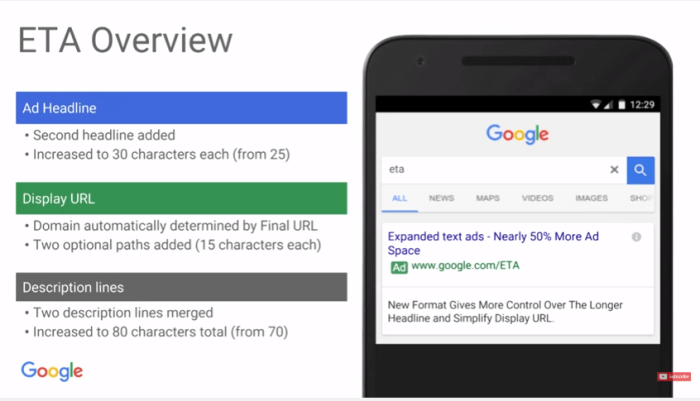

Google discontinuing expanded text ads etas – Google discontinuing expanded text ads (ETAs) is a significant shift in the online advertising landscape. This change will impact advertisers in numerous ways, forcing a reassessment of strategies and potentially altering overall ad spending. Understanding the reasons behind this decision, the potential alternatives, and the technical adjustments required is crucial for navigating this transition successfully.
This comprehensive guide dives into the impact on advertisers, exploring alternative ad formats, Google’s reasoning, technical implications, and the broader future of online advertising. We’ll also examine the potential effects on user experience.
Impact on Advertisers
Google’s discontinuation of Expanded Text Ads (ETAs) presents a significant shift for advertisers reliant on this format. The change necessitates a proactive adaptation of marketing strategies to maintain optimal campaign performance. Advertisers must carefully evaluate their current campaign structure and identify alternative approaches to ensure continued success.
Potential Effects on Advertisers
The discontinuation of ETAs will likely impact advertisers in several ways. Advertisers who heavily relied on the specific features of ETAs, such as the ability to showcase multiple headlines and descriptions, will need to adjust their messaging and targeting. The loss of ETAs’ versatility may result in reduced click-through rates (CTRs) and conversions for some campaigns, depending on the specific campaign structure and targeting.
The impact on overall ad spend is dependent on how effectively advertisers transition to alternative formats and adjust their strategies. Businesses may see a temporary dip in campaign effectiveness while they adapt.
Shift in Strategies for Advertisers, Google discontinuing expanded text ads etas
Advertisers will need to transition to alternative ad formats, such as Responsive Search Ads (RSAs) or other ad types offered by Google. This transition will require understanding the strengths and weaknesses of different formats. Campaign optimization strategies must be re-evaluated, focusing on the specific features of the new formats to maximize performance. Advertisers should consider A/B testing different ad variations to identify the most effective approaches for their specific target audiences and campaigns.
Google’s discontinuation of Expanded Text Ads (ETAs) is a significant change, forcing us to rethink our strategies. One key adjustment is optimizing for local search, and that means understanding how to rank in multiple cities with one website. Learning techniques like location targeting and structured data can be highly beneficial for broader reach. This will help your site get more visibility in local searches, which is crucial in today’s digital landscape, especially now that ETAs are going away.
Check out this guide on how to rank in multiple cities with one website for more detailed insights into adapting to these changes.
Comparison of ETAs and Alternative Ad Formats
| Feature | Expanded Text Ads (ETAs) | Responsive Search Ads (RSAs) | Other Formats |
|---|---|---|---|
| Headline Structure | Fixed headlines, limited flexibility | Dynamic headline generation from provided text | Variations based on the specific format (e.g., shopping ads, video ads) |
| Description Structure | Fixed descriptions, limited flexibility | Dynamic description generation from provided text | Format-specific descriptions (e.g., product details for shopping ads) |
| Targeting Options | Standard targeting options | Standard targeting options | Format-specific targeting options |
| Strengths | Clear, concise messaging; easy to manage for simple campaigns. | Dynamically generates optimized headlines and descriptions for broader reach; highly flexible. | Optimized for specific marketing objectives (e.g., product showcases, video engagement). |
| Weaknesses | Limited adaptability to diverse search queries; less efficient for complex campaigns. | Requires more setup and potentially longer optimization periods. | Can be more complex to manage, may not be suitable for all campaigns. |
Strategies to Mitigate the Impact
Implementing the following strategies can help mitigate the impact of the change:
- Thorough Campaign Assessment: Carefully analyze existing campaign performance, identify strengths and weaknesses of current ETA structures, and pinpoint specific target audience characteristics. This assessment helps define the best path forward.
- Extensive Testing of Alternative Formats: Actively test various ad formats like RSAs and others, gathering data on their performance. This allows for optimized campaign configurations to maximize CTR and conversions. Real-world examples demonstrate that A/B testing is crucial for identifying the best approach.
- Refined Targeting: Review and refine targeting strategies to ensure alignment with the new ad formats. This strategy ensures relevance to user searches, enhancing campaign efficiency.
- Emphasis on Landing Page Optimization: Ensure that landing pages are optimized to align with the messaging and targeting of the new ad formats, guaranteeing a seamless user experience.
Alternative Ad Formats
The discontinuation of Expanded Text Ads (ETAs) forces advertisers to explore alternative ad formats. This shift presents both challenges and opportunities. Advertisers need to adapt their strategies and learn new tools to maintain and potentially improve their campaign performance. This exploration dives into the evolving landscape of ad formats, examining their potential, performance metrics, and learning curves.The shift away from ETAs necessitates a strategic reassessment of ad formats.
Advertisers must adapt their campaigns to maximize their ROI in the face of evolving platform algorithms and user behaviors. The exploration of alternative formats offers a chance to explore new avenues for reaching target audiences effectively.
Potential Rise in Popularity of Alternative Formats
The discontinuation of ETAs is likely to spur a significant increase in the adoption of alternative ad formats. These formats often offer more granular targeting, greater creative flexibility, and potentially improved conversion rates compared to ETAs. The increased demand will likely drive innovation and improvements in these formats.
Examples of Alternative Formats and Their Functionalities
Various alternative ad formats cater to different advertising objectives and campaign strategies.
- Image Ads: These ads leverage visual appeal to capture attention. They can be static or animated, allowing for a more engaging experience for users. Their effectiveness hinges on strong visuals and compelling copy that complements the image. Image ads are suitable for various industries and can be tailored for specific demographics and interests.
- Video Ads: These ads use moving images and audio to convey messages. They are often more engaging and memorable than static images, but production costs and targeting options can vary. Short-form video ads are especially effective for capturing attention in the fast-paced online environment.
- Shopping Ads: These ads focus on showcasing products directly to potential customers. They often feature product images, pricing, and details, making them excellent for e-commerce campaigns. Shopping ads are highly targeted, driving traffic to specific product pages.
- Responsive Search Ads: These ads adapt to various search queries, delivering tailored messages based on user searches. They are dynamic and can be highly effective for campaigns with multiple target s.
- Gmail Ads: These ads appear within Gmail inboxes, allowing for targeted messaging within a user’s primary communication channel. Their effectiveness depends on the relevance and clarity of the message, and how well they integrate with the user experience.
Comparison of Performance Metrics of ETAs and Alternatives
A direct comparison of performance metrics between ETAs and alternative formats is complex. Factors such as campaign objectives, target audience, and creative execution significantly impact results. While ETAs excel at reaching users actively searching for specific information, alternative formats can better capture attention and drive engagement, potentially leading to higher click-through rates and conversions, especially for campaigns focused on brand awareness and engagement.
Strengths and Weaknesses of Alternative Formats
Each alternative format presents unique strengths and weaknesses. The choice of format depends on the specific campaign goals and the target audience.
- Image Ads: Strengths include visual appeal and broad reach. Weaknesses include limited space for text and potential for lower click-through rates compared to more interactive formats.
- Video Ads: Strengths include higher engagement and memorability. Weaknesses include higher production costs and varying targeting options.
- Shopping Ads: Strengths include direct product showcasing and higher conversion potential. Weaknesses include a need for product data and may not be suitable for all industries.
- Responsive Search Ads: Strengths include adaptability to diverse user searches. Weaknesses include potential for decreased precision in targeting compared to traditional search ads.
- Gmail Ads: Strengths include high relevance within a user’s primary communication channel. Weaknesses include potential for lower reach compared to broader search campaigns.
Learning Curve for Advertisers Transitioning to New Formats
Transitioning to new ad formats requires advertisers to learn new tools and platforms. This includes understanding the nuances of each format, optimizing campaigns for maximum performance, and tracking key metrics. Training resources and online communities can support advertisers in navigating this learning curve. The process of learning new formats may involve experimenting with different approaches and strategies.
Google’s Reasoning and Strategy
Google’s decision to discontinue Expanded Text Ads (ETAs) signals a shift in its advertising strategy, reflecting evolving user behavior and a focus on more sophisticated ad formats. This change underscores Google’s ambition to optimize the user experience while simultaneously maximizing revenue through different avenues. The implications extend beyond just advertisers adapting to new ad formats; they also affect Google’s overall revenue model and the future of the digital advertising landscape.Google’s rationale for phasing out ETAs likely stems from several factors.
The company likely recognizes that ETAs, while historically effective, may not be as engaging or relevant to users as newer ad formats. This transition suggests a move towards more dynamic and personalized advertising experiences, potentially integrating machine learning and AI to better match ads with user interests.
Stated Reasons for Discontinuation
Google has explicitly cited the need to improve the user experience as a key driver for this change. They emphasize that more sophisticated ad formats can better cater to user needs and deliver more relevant results. The transition away from ETAs is also likely part of a larger strategy to evolve its advertising ecosystem, potentially to better align with the increasing use of mobile devices and the growing prevalence of video content.
Potential Motivations and Future Strategies
Several potential motivations lie behind Google’s decision. Firstly, the move may be part of a broader effort to enhance the quality of search results, leading to a better user experience. Secondly, it may be a strategic response to the growing popularity of other ad formats, such as video and display ads, which Google can now better integrate into its platform.
A third possibility is that Google anticipates future revenue streams from these new ad formats to outweigh the revenue lost from ETAs.
Potential Long-Term Implications for the Advertising Landscape
The discontinuation of ETAs will undoubtedly reshape the advertising landscape. Advertisers will need to adapt to new formats, potentially leading to a greater emphasis on performance-based advertising and a more nuanced understanding of user behavior. The transition will likely spur innovation in ad technology and further differentiate the value proposition of different advertising platforms. This could also create opportunities for smaller players in the advertising market.
Impact on Google’s Overall Revenue Model
The discontinuation of ETAs could affect Google’s overall revenue model in both positive and negative ways. A short-term dip in revenue from ETAs is possible, but this is likely to be offset by potential increases in revenue from alternative ad formats. The long-term impact will depend on the effectiveness of the new formats and the adoption rate of advertisers and users.
Timeline of Announcements and Updates
| Date | Event |
|---|---|
| October 26, 2023 | Google announces the discontinuation of ETAs. |
| November 15, 2023 | Google provides detailed information on alternative ad formats. |
| December 1, 2023 | Google releases updated support documents and training materials for advertisers. |
Technical Implications

The discontinuation of Expanded Text Ads (ETAs) necessitates significant technical adjustments for advertisers. This shift requires a thorough understanding of the new ad formats and the process of migrating existing campaigns. Failing to plan for these changes could result in lost reach and diminished ROI.
Technical Adjustments for Advertisers
Advertisers need to familiarize themselves with the new ad formats and their corresponding technical specifications. This includes understanding the structure, limitations, and functionalities of the alternative formats Google provides. For instance, advertisers will need to adjust their creative assets to comply with the specifications of the new formats.
Compatibility Issues with Existing Ad Platforms
Some existing ad platforms might not fully support the new ad formats. This could lead to compatibility issues, requiring modifications to the ad platform setup or even a complete switch to a platform that fully integrates with the new Google ad formats. Testing and validation of the compatibility of the new ad formats with existing ad platforms are critical to a smooth transition.
Migrating Campaigns from ETAs to Alternative Formats
The migration process involves transferring existing ETA campaigns to the new ad formats. This includes ensuring the data and targeting parameters are accurately transferred to maintain the campaign’s performance. Google will likely provide tools and resources to aid in this migration process.
Best Practices for a Smooth Transition
A smooth transition requires a proactive approach. This includes:
- Thorough Campaign Analysis: Analyze current ETA campaigns to understand their performance, targeting, and key metrics. This analysis will guide the optimization of the migrated campaigns.
- Early Adoption of New Formats: Begin experimenting with alternative formats early in the transition period to gain familiarity and identify potential issues.
- Comprehensive Testing: Rigorously test the migrated campaigns to ensure they perform as expected and address any compatibility issues.
- Regular Monitoring: Continuously monitor campaign performance after migration to identify and address any issues quickly.
Step-by-Step Guide to a Successful Transition
A successful transition follows a structured approach:
- Assessment of Existing Campaigns: Review current ETA campaigns, identifying key performance indicators (KPIs), target demographics, and budget allocations.
- Exploration of Alternative Formats: Understand the capabilities and limitations of the new ad formats provided by Google. Familiarize yourself with the available creative asset specifications and targeting options.
- Campaign Conversion: Utilize Google’s provided tools and resources to migrate existing ETA campaigns to the new ad formats, ensuring accurate data transfer.
- Testing and Optimization: Rigorously test the migrated campaigns across various devices and platforms. Optimize targeting and bidding strategies based on the results of this testing phase.
- Post-Migration Monitoring: Continuously monitor the performance of the migrated campaigns to ensure they meet or exceed the previous performance metrics.
Future of Advertising
The discontinuation of Expanded Text Ads (ETAs) marks a significant shift in the online advertising landscape. This change forces a reevaluation of strategies and necessitates adaptation to evolving user expectations and technological advancements. The future of online advertising is no longer solely defined by text-based ads; instead, it’s becoming increasingly intertwined with dynamic, visually-rich experiences and sophisticated targeting mechanisms.The impact of this change extends beyond individual advertisers.
It fundamentally alters the way users interact with online content, potentially impacting the overall user experience. Advertisers need to embrace innovative formats and strategies to remain competitive in a constantly shifting market. The transition also presents opportunities for new ad formats and platforms to emerge, potentially reshaping the very structure of online advertising.

Google’s decision to phase out Expanded Text Ads (ETAs) is definitely a game-changer for advertisers. Fortunately, there are plenty of alternatives, and exploring tools like HubSpot’s AI-powered CRM and marketing automation platform, hubspot ai crm marketing automation , can help businesses adapt and stay competitive. Now, finding the right strategies to replace ETAs is key for maintaining successful online campaigns.
Broader Implications for Online Advertising
The discontinuation of ETAs signals a move away from simple text-based ads toward more complex, engaging, and targeted approaches. This shift necessitates a greater emphasis on visual elements, interactive experiences, and contextual relevance. The future of online advertising will be increasingly focused on delivering value to both advertisers and users.
Potential Impact on User Experience
The evolution of ad formats directly impacts the user experience. Simple, intrusive ads can disrupt the user flow, leading to frustration. However, well-integrated and contextually relevant ads can enhance the browsing experience, providing value and information without detracting from the core content. A focus on user experience will be critical to maintain user engagement and satisfaction in the long term.
Impact on Future Ad Formats
The decline of ETAs will drive innovation in ad formats. Expect to see a rise in interactive ads, video ads, and immersive experiences that seamlessly integrate with the content users are consuming. These innovative formats will allow for a more targeted and engaging approach to advertising, potentially leading to a more positive user experience.
Google’s recent decision to discontinue Expanded Text Ads (ETAs) is a significant shift, forcing advertisers to adapt. Fortunately, if you’re looking to safeguard your valuable content, consider methods like restricting access to your WordPress site for Patreon members, as outlined in this helpful guide: how to restrict content on wordpress to patreon members. This approach allows you to monetize your work effectively, which is even more important now that Google’s changing the game with ETAs.
Ultimately, creators need to find new ways to connect with audiences and maintain a steady income stream.
Emerging Trends in Online Advertising
Several emerging trends are reshaping the online advertising landscape. These include the increasing use of artificial intelligence (AI) for ad targeting and personalization, the growing importance of contextual advertising, and the rise of programmatic advertising. The combination of these trends will likely lead to more sophisticated and effective ad campaigns, ultimately influencing user experience.
Predicted Market Shifts
| Year | Trend | Impact on Advertisers | Impact on Users |
|---|---|---|---|
| 2024 | Rise of AI-powered ad targeting | Increased efficiency in reaching specific demographics, improved ROI. | Potentially more relevant ads, but risk of over-targeting and intrusive ads if not managed responsibly. |
| 2025 | Emphasis on contextual advertising | More relevant ads based on user activity, improved brand relevance. | Reduced ad fatigue, improved user experience if contextualization is done well. |
| 2026 | Growth of immersive ad formats | Enhanced engagement and brand interaction, potentially higher conversion rates. | More interactive and engaging experience, potentially more appealing, but could lead to ad fatigue if not implemented thoughtfully. |
| 2027 | Increased use of programmatic advertising | Greater automation and optimization of ad campaigns, reduced manual intervention. | Potential for increased ad frequency and potentially intrusive ads, if not controlled effectively. |
User Experience: Google Discontinuing Expanded Text Ads Etas
The discontinuation of Expanded Text Ads (ETAs) will undoubtedly impact the user experience on Google platforms. While Google aims to enhance the overall experience, the transition presents both potential improvements and drawbacks for users. Understanding these shifts is crucial for navigating the changing advertising landscape.
Potential Impact on Ad Visibility and Relevance
The disappearance of ETAs could lead to a noticeable change in ad visibility. The design and placement of alternative ad formats might affect the prominence of ads on search results pages. Users might encounter fewer visually engaging ads, potentially leading to a perception of decreased ad density. Conversely, users might perceive a decrease in ad relevance as advertisers adjust to the new ad formats.
This could stem from the limitations of some alternative formats in conveying the same level of detail as ETAs. The ability to showcase specific product features or promotions might be reduced. The key is how well alternative ad formats effectively communicate the essential product information.
Negative User Experiences
One potential negative user experience involves a perceived decrease in the amount of information available to users within the ad. Users accustomed to the detailed descriptions in ETAs may find it harder to quickly identify relevant results. This could result in increased time spent on searching for the desired information. Additionally, a reduction in the diversity of ad formats might lead to a less varied and dynamic experience for users.
The new ad formats might be perceived as less appealing or less informative than the ETAs.
Enhancements to User Experience
Several strategies can enhance the user experience after the transition. Firstly, Google can prioritize ad relevance through rigorous testing and optimization of alternative ad formats. Secondly, Google should ensure a clear and informative transition process to help users adapt to the new ad ecosystem. Clear guidance on navigating the updated ad formats will ease user confusion. Providing educational resources for advertisers on how to effectively utilize the new formats will further support user experience.
Lastly, user feedback mechanisms should be actively employed to identify and address any emerging issues.
Improvements in User Experience with Alternative Ad Formats
Alternative ad formats offer opportunities to improve user experience. For example, image-heavy ads or video ads can provide a more engaging visual experience, potentially leading to a higher level of user interest and click-through rates. In turn, this increased engagement may lead to a higher degree of relevance and a better overall user experience. Similarly, interactive ads, if designed effectively, can provide users with more personalized experiences.
This personalization can lead to better user engagement and a higher perception of ad relevance.
Outcome Summary
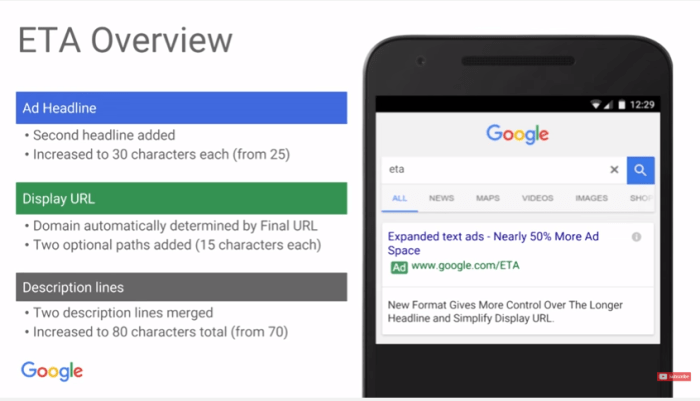
The discontinuation of ETAs marks a pivotal moment in online advertising. Advertisers must adapt to new formats, potentially impacting ad spending and strategies. Understanding the technical implications, alternative options, and Google’s reasoning is crucial for navigating this change. Ultimately, this shift promises a dynamic evolution of online advertising, demanding vigilance and adaptability from all involved.