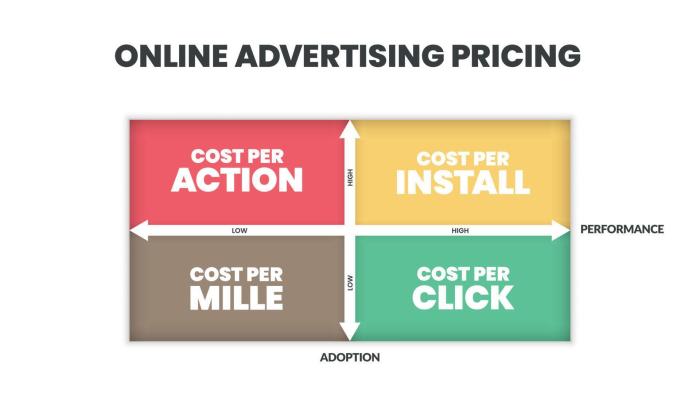

Digital advertising pricing model is a complex landscape, influencing everything from campaign success to return on investment. Understanding the different pricing structures, like Cost Per Click (CPC), Cost Per Mille (CPM), and Cost Per Acquisition (CPA), is crucial for advertisers and publishers alike. This exploration delves into the factors that drive pricing decisions, from campaign goals to platform features, providing a comprehensive overview for anyone navigating the digital advertising world.
We’ll examine how audience targeting, platform characteristics, and market competition all play a role in shaping pricing strategies across various industries, including e-commerce, finance, and entertainment. We’ll also explore negotiation and bidding strategies, along with the impact of emerging technologies like programmatic advertising and AI-powered bidding. Finally, we’ll analyze the pricing models of major platforms like Google Ads and Facebook Ads, providing a practical guide for making informed decisions in the dynamic world of digital advertising.
Defining Digital Advertising Pricing Models
Digital advertising offers a diverse range of pricing models, each catering to different needs and objectives. Understanding these models is crucial for both advertisers seeking optimal ROI and publishers maximizing revenue. This section delves into the specifics of various pricing models, highlighting their nuances and implications.Different digital advertising pricing models reflect the varying complexities of online campaigns and the diverse needs of both advertisers and publishers.
Each model has unique characteristics, influencing how the cost is allocated and the results measured.
Figuring out digital ad pricing models can be tricky, especially when you’re trying to stay ahead of the curve. Understanding how to navigate the new normal in hospice marketing, like the trends discussed in navigating the new normal hospice marketing trends in the digital era , is crucial. Ultimately, a strong grasp of these models is key to success in today’s digital advertising landscape.
Cost Per Click (CPC)
CPC, or Cost Per Click, is a common model where advertisers pay the publisher only when a user clicks on their ad. This model incentivizes publishers to display ads prominently and relevantly, aiming to attract qualified clicks. Advertisers benefit from a predictable cost structure, directly linked to user engagement. For example, a retailer might pay $0.50 each time a user clicks on their product ad, resulting in a potentially higher return on investment if the click leads to a sale.
Cost Per Mille (CPM)
CPM, or Cost Per Mille (a Latin abbreviation meaning “thousand”), represents the cost an advertiser pays per one thousand impressions of their ad. An impression is simply a view of the ad. This model focuses on ad visibility and brand awareness, making it suitable for campaigns aiming to reach a broad audience. A publisher’s revenue depends on the number of times an ad is displayed, not on user engagement.
For instance, a company might pay $5 per one thousand views of a banner ad on a website.
Cost Per Acquisition (CPA)
CPA, or Cost Per Acquisition, is a performance-based model where the advertiser pays the publisher only when a specific action, such as a sale or lead generation, is completed. This model is highly effective for driving conversions and ensuring a tangible return on investment. Advertisers pay based on the desired outcome, making it a robust metric for measuring campaign effectiveness.
Figuring out digital ad pricing models can be tricky, right? One thing that often gets overlooked is how to stay on top of your website’s content updates. Knowing how to get email notifications for post changes in WordPress, like how to get email notifications for post changes in wordpress , is crucial. This helps you monitor your content’s performance and adapt your ad strategies accordingly, which in turn gives you a better handle on your overall digital advertising pricing model.
For example, a company might pay $25 each time a user completes a purchase through an ad campaign.
Cost Per View (CPV)
CPV, or Cost Per View, is a pricing model where the advertiser pays for each time a video ad is fully viewed. This is common in video advertising, where the value is directly tied to the user watching the entire ad. Advertisers pay for the full view, ensuring that users are engaged with the content. This model is often utilized in pre-roll video ads.
Other Models
Several other pricing models exist, including cost per engagement (CPE), cost per lead (CPL), and cost per action (CPA). These models focus on specific actions users take, providing a flexible framework for advertising objectives. For example, CPE focuses on user interactions beyond clicks, while CPL targets users who provide their contact information.
Factors Influencing Model Choice
Several factors influence the choice of a pricing model, including the advertiser’s goals, budget, target audience, and desired outcomes. Campaign objectives, such as brand awareness or direct sales, significantly impact the optimal pricing model. For example, if a company prioritizes immediate sales, CPA might be the most effective choice.
Comparison Table of Pricing Models
| Model Name | Description | Key Metrics | Advantages | Disadvantages |
|---|---|---|---|---|
| Cost Per Click (CPC) | Pay per click on an ad. | Clicks, Click-Through Rate (CTR) | Predictable cost, focus on engagement. | May not always drive conversions. |
| Cost Per Mille (CPM) | Pay per one thousand impressions. | Impressions, Reach | Focus on brand awareness, broad reach. | Less focused on conversions, harder to measure ROI. |
| Cost Per Acquisition (CPA) | Pay per desired action (e.g., sale, lead). | Conversions, Cost per Conversion | Directly linked to conversions, high ROI potential. | Higher cost uncertainty, longer time to measure results. |
| Cost Per View (CPV) | Pay per view of a video ad. | Views, Completion Rate | Suitable for video ads, focuses on user engagement. | Requires dedicated user attention. |
Factors Affecting Pricing
Digital advertising pricing is a complex interplay of various factors. Understanding these factors is crucial for both advertisers and publishers to make informed decisions and maximize return on investment (ROI). Pricing models are not static; they adapt to market conditions, platform innovations, and evolving user behaviors. This dynamic nature necessitates a nuanced understanding of the key drivers.Pricing decisions in the digital advertising landscape are significantly influenced by several interconnected elements.
These range from the specific objectives of the campaign to the characteristics of the chosen platform, and even the competitive landscape. This detailed exploration will illuminate the key forces shaping the cost of digital advertising.
Campaign Objectives
Campaign objectives directly influence pricing. A brand aiming for immediate brand awareness might opt for a different strategy and pricing than one focused on driving high-volume sales conversions. For example, a campaign focused on brand awareness may use broad targeting and less expensive ad formats, while a campaign focused on direct sales may utilize more specific targeting and premium ad formats.
Target Audience
Audience targeting plays a pivotal role in determining advertising costs. The more specific and refined the targeting, the higher the cost is likely to be. Precise targeting allows for higher relevance and engagement, often leading to a higher return on ad spend (ROAS). For example, a campaign targeting tech-savvy millennials in a specific geographic area will command a higher price than a campaign targeting a broader demographic.
Platform Characteristics
Platform characteristics significantly impact pricing. Platforms with higher user engagement, stronger brand recognition, and a wider audience tend to command higher ad rates. Ad formats, ad placement, and the platform’s overall user experience also influence pricing. For instance, a video ad on a highly trafficked social media platform will likely cost more than a text ad on a less popular blog.
Seasonality
Seasonality is a factor in pricing fluctuations. Certain times of the year, like the holiday shopping season, see increased advertising demand and thus, higher prices. This is particularly evident in e-commerce and retail sectors. For instance, advertisers often see higher costs during Black Friday and Cyber Monday.
Competition
Competition in the digital advertising space is fierce. When numerous advertisers compete for the same audience, prices tend to rise. Competition influences pricing strategies, forcing advertisers to be more strategic and targeted to stand out. For example, a crowded market for mobile app downloads will often see higher bidding prices for ad impressions.
Audience Targeting Impact on Costs
The level of specificity in audience targeting directly impacts advertising costs. Broad targeting, encompassing a large audience, generally results in lower costs. Conversely, precise targeting, focusing on a specific demographic or user segment, often leads to higher prices. This is due to the increased efficiency and effectiveness of reaching the desired audience.
Platform Features and Ad Formats
The features of a particular advertising platform and the ad formats used significantly impact pricing. Platforms with unique features, like interactive elements or video integration, can command higher rates. The complexity and sophistication of an ad format can also affect pricing. For instance, a sophisticated interactive video ad will likely cost more than a simple banner ad.
Impact of Competition on Pricing Strategies
The level of competition directly influences pricing strategies. In highly competitive markets, advertisers must be more strategic in their bidding and targeting to stand out. Increased competition can lead to higher bidding prices, necessitating more precise targeting and creative optimization to secure desired results.
| Factors Influencing Pricing | Impact on Pricing |
|---|---|
| Campaign Objectives | Directly influences pricing based on the desired outcomes (brand awareness, sales, etc.). |
| Target Audience | More specific targeting often results in higher costs. |
| Platform Characteristics | Platforms with higher engagement and wider reach command higher rates. |
| Seasonality | Demand increases during peak seasons, leading to higher prices. |
| Competition | Increased competition leads to higher bidding prices. |
Pricing Strategies and Models in Different Sectors: Digital Advertising Pricing Model
Digital advertising pricing models are far from one-size-fits-all. Understanding how these models vary across industries and platforms is crucial for effective campaign management and budget allocation. Different sectors have unique needs and expectations, leading to diverse approaches to advertising spend. This section explores the nuances of pricing strategies in various industries, highlighting the specific models used and their effectiveness.Various factors influence the cost of digital advertising, including the platform, target audience, campaign goals, and industry benchmarks.
Understanding these variations allows advertisers to optimize their campaigns and maximize return on investment (ROI).
E-commerce Pricing Models
E-commerce advertising often relies on performance-based models, such as cost-per-click (CPC) and cost-per-acquisition (CPA). These models directly tie ad spend to tangible results, making them attractive to businesses focused on driving sales. Auction-based systems are common, where advertisers bid on s or placements to reach potential customers. The competitiveness of the s significantly impacts the cost. High-demand s often result in higher bids.
Finance Pricing Models
The financial sector, with its regulatory constraints and focus on compliance, often employs a blend of performance-based and fixed-price models. While CPC and CPA are used, fixed-price packages tailored to specific goals, such as lead generation or brand awareness, are also common. Due to the sensitivity of financial data, compliance with privacy regulations is a critical aspect of these campaigns.
Entertainment Pricing Models
Entertainment companies, particularly those involved in streaming services, leverage a variety of pricing models, including CPC, CPM (cost-per-thousand impressions), and even fixed-price partnerships. The target audience and platform greatly influence the chosen pricing model. CPM is often used for broader reach campaigns aimed at building brand awareness. Fixed-price deals with media outlets for pre-roll or sponsored content are common strategies.
Pricing Variations Across Platforms, Digital advertising pricing model
Digital advertising platforms, like Google Ads and social media platforms, offer varying pricing structures. Google Ads often utilizes auction-based systems for bidding, impacting CPC. Social media platforms, while also employing auctions, may feature more nuanced targeting options, affecting pricing. The specific platform’s algorithm and user engagement patterns also play a crucial role.
Comparison of Pricing Models Across Industries
| Industry | Common Pricing Models | Average Pricing Range (USD) |
|---|---|---|
| E-commerce | CPC, CPA, CPM | $0.50 – $50+ per click/action |
| Finance | CPC, CPA, Fixed-price packages | $1 – $100+ per click/lead |
| Entertainment | CPC, CPM, Fixed-price deals | $5 – $100+ per thousand impressions/deal |
Note: Average pricing ranges are estimates and may vary significantly based on factors like campaign complexity, competition, and targeting.
Negotiation and Bidding Strategies
Digital advertising pricing is rarely a fixed number. Instead, it’s a dynamic process often involving negotiation and strategic bidding. Understanding these tactics is crucial for advertisers looking to maximize their return on ad spend (ROAS) and publishers seeking optimal revenue generation. The landscape is complex, influenced by various factors such as campaign scope, target audience, and platform specifics.Negotiation plays a significant role in setting advertising prices, particularly for large-scale campaigns.
Figuring out digital ad pricing models can be tricky, right? Understanding the intricacies of how Facebook ad campaigns work is key, especially when considering factors like the “click gap” and SEO. For example, if you’re looking at Facebook ad performance, you need to consider how those clicks translate to conversions, and facebook click gap and seo plays a big role in this.
Ultimately, the right pricing model depends on your specific goals and budget for your digital advertising strategy.
Advertisers and publishers often engage in discussions to agree on mutually beneficial terms, taking into account campaign objectives, expected reach, and the overall value exchange. This process allows for customized pricing structures that reflect the unique demands and opportunities of each campaign.

Negotiation in Large-Scale Campaigns
Negotiation in large-scale campaigns often involves multiple parties and complex agreements. Publishers might offer volume discounts, especially for consistent or long-term partnerships. Advertisers might seek premium placement guarantees, such as top-of-page or high-impact ad slots, which command higher prices. The negotiations often involve detailed discussions on campaign metrics, reporting requirements, and performance benchmarks. Ultimately, both sides strive to optimize their return on investment.
Bidding Strategies for Optimal Ad Placements
Advertisers employ various bidding strategies to secure optimal ad placements at competitive prices. These strategies are often automated, leveraging algorithms to evaluate real-time data and make adjustments dynamically. Examples include:
- Cost Per Click (CPC) bidding: Advertisers pay only when a user clicks on their ad. This strategy is effective for driving traffic to specific landing pages. For example, an e-commerce company might use CPC bidding to target users searching for specific products.
- Cost Per Mille (CPM) bidding: Advertisers pay for every 1000 impressions of their ad. This is suitable for brand awareness campaigns where the goal is to reach a large audience. A company launching a new product might use CPM to maximize visibility.
- Target CPA bidding: This approach focuses on achieving a specific cost per acquisition (CPA). Advertisers set a target CPA and the platform optimizes bids to reach that goal. For instance, a company running a lead generation campaign might use Target CPA to minimize the cost of acquiring each lead.
Real-Time Bidding (RTB) in Dynamic Pricing Models
Real-time bidding (RTB) is crucial in dynamic pricing models. It allows advertisers to bid on ad impressions in real time, taking into account factors like audience demographics, website context, and the ad’s relevance to the user. The bidding process happens instantly, ensuring that the ad placement is highly relevant and cost-effective.
Flowchart of a Typical Bidding Process
| Step | Description |
|---|---|
| 1. Impression Request | A website requests an ad impression. |
| 2. Ad Exchange | The request goes to an ad exchange, a central marketplace for ad impressions. |
| 3. Bid Request | The ad exchange sends a bid request to participating advertisers. |
| 4. Bid Submission | Advertisers submit bids based on various criteria. |
| 5. Auction | The ad exchange conducts a real-time auction to determine the winning bid. |
| 6. Ad Serving | The winning advertiser’s ad is served to the user. |
| 7. Measurement | Performance metrics are recorded for analysis and optimization. |
Emerging Trends and Future of Pricing Models

The digital advertising landscape is constantly evolving, driven by innovative technologies and shifting consumer behaviors. Pricing models are adapting to these changes, reflecting the complexities of programmatic buying, AI-driven optimization, and the increasing importance of data-driven audience targeting. Understanding these emerging trends is crucial for businesses to navigate the future of digital advertising effectively.The future of digital advertising pricing hinges on the ability to accurately assess and optimize ad spend.
This requires a sophisticated understanding of emerging technologies and their impact on campaign performance. New pricing models are arising that consider factors beyond traditional metrics like CPM or CPC, embracing a more nuanced approach to value exchange.
Programmatic Advertising and Automation
Programmatic advertising is revolutionizing the way ads are bought and sold. Automated systems facilitate real-time bidding, allowing for highly targeted campaigns. This trend leads to more efficient allocation of ad budgets and often higher conversion rates. The key is the ability to leverage vast datasets and sophisticated algorithms to optimize ad placement in real-time, delivering personalized ads to the right audience at the right moment.
AI-Powered Bidding and Optimization
AI is increasingly being used to refine bidding strategies. AI algorithms can analyze vast amounts of data to predict user behavior, optimize ad placement, and maximize return on ad spend (ROAS). This technology enables more precise targeting, dynamic pricing, and automated adjustments to campaigns in real-time. This leads to better results for advertisers and publishers.
Audience-Based Pricing Models
Traditional pricing models often focus on impressions or clicks. Emerging models, however, emphasize audience value. Companies are beginning to charge based on the value of the audience reached, considering factors like engagement, demographics, and purchasing intent. This approach provides advertisers with a more personalized and targeted experience. For example, a company selling luxury goods might pay a premium to target high-net-worth individuals, recognizing the greater potential return on investment from that specific audience.
Data-Driven Pricing and Transparency
Data transparency is becoming a crucial factor in digital advertising pricing. Advertisers are demanding more clarity on how data is used and how pricing is determined. This shift toward greater transparency benefits advertisers, who can make informed decisions, and publishers, who can establish trust. Examples include open data initiatives, detailed reporting, and clear pricing structures that showcase the value proposition.
Challenges and Opportunities
The shift towards automated bidding and audience-based pricing presents both challenges and opportunities. Advertisers need to adapt to new technologies and understand how to leverage them effectively. The ability to interpret data and develop sophisticated strategies is critical for success. Conversely, the ability to precisely measure the value of audience segments, combined with the right tools and strategies, can open new avenues for growth and innovation.
Emerging Trends and Potential Impact on Pricing Models
| Emerging Trend | Potential Impact on Pricing Models |
|---|---|
| Programmatic Advertising | Increased efficiency, real-time bidding, and more targeted campaigns; potentially lower CPMs for high-quality inventory. |
| AI-Powered Bidding | Dynamic pricing, automated optimization, and higher ROAS; potentially more granular and personalized pricing based on predicted user behavior. |
| Audience-Based Pricing | Value-based pricing; premium pricing for high-value audiences; need for sophisticated audience segmentation and measurement. |
| Data-Driven Pricing and Transparency | Increased transparency in pricing structures; more informed decisions for advertisers; greater trust and accountability for publishers. |
Analyzing Specific Platforms and Their Pricing
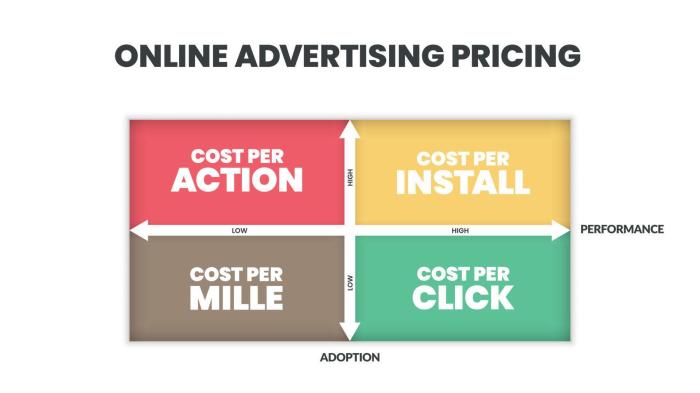
Digital advertising platforms offer a diverse array of pricing models, each tailored to specific campaign objectives and target audiences. Understanding these nuances is crucial for maximizing ROI and achieving desired results. Different platforms employ varying strategies, making a comprehensive understanding essential for advertisers to choose the best fit for their needs.A key aspect of evaluating digital advertising platforms is their pricing structures.
Platforms like Google Ads, Facebook Ads, and Bing Ads each employ unique mechanisms for determining costs, often based on factors such as bid strategies, ad quality, and audience targeting. By analyzing these specifics, advertisers can optimize campaigns for optimal performance and cost-effectiveness.
Google Ads Pricing
Google Ads, the dominant player in the search advertising space, utilizes a pay-per-click (PPC) model. Advertisers bid on s relevant to their target audience. The actual cost depends on the competition for those s, with higher competition leading to higher bids. Quality score, a metric reflecting ad relevance and user experience, significantly influences the cost-per-click (CPC). Higher quality scores typically translate to lower CPCs, as Google prioritizes ads that provide a good user experience.
Facebook Ads Pricing
Facebook Ads operates on a complex bidding system, often incorporating factors like campaign objectives, target audience demographics, and ad creative quality. While the platform offers various bidding options, the core principle remains a cost-per-result (CPR) approach. Advertisers can specify their desired outcome, whether it’s website clicks, app installs, or conversions, and the platform dynamically adjusts bids to achieve those targets.
This flexibility allows for tailored campaigns but can sometimes lead to higher costs for complex objectives.
Bing Ads Pricing
Bing Ads, a secondary search advertising platform, also employs a pay-per-click (PPC) model. Similar to Google Ads, advertisers bid on s, and the cost depends on competition and quality score. Bing Ads frequently offers competitive bidding opportunities compared to Google Ads, particularly for niche s. The platform often emphasizes a more targeted approach, offering specific tools and targeting options.
Pricing Model Comparison Table
| Platform | Pricing Model | Key Features | Typical Costs |
|---|---|---|---|
| Google Ads | Pay-per-click (PPC) | bidding, quality score, various campaign types | Varies significantly depending on competition and quality score, from a few cents to several dollars per click. |
| Facebook Ads | Cost-per-result (CPR) or other bidding types | Detailed targeting options, campaign objectives, flexible bidding strategies | Varies depending on campaign objectives, target audience, and competition, ranging from a few cents to several dollars per result. |
| Bing Ads | Pay-per-click (PPC) | bidding, quality score, competitive pricing for niche s | Generally lower than Google Ads for comparable s, but still variable based on competition. |
End of Discussion
In conclusion, the digital advertising pricing model is a multifaceted system influenced by numerous factors. From basic pricing models to sophisticated bidding strategies and emerging technologies, understanding the intricacies of this system is key to maximizing ROI and achieving campaign objectives. This comprehensive exploration provides a framework for navigating the complexities of digital advertising pricing, empowering both advertisers and publishers to make informed decisions and optimize their strategies in this ever-evolving landscape.